SIMPLY BUSINESS HUB · FREE STARTER GUIDE · INDIA EDITION · UPDATED 2 OCTOBER 2026
Push Pop Tiramisu Business in India: A Practical Starting Guide
Research cut-off: 2 October 2026 · Cost: Free · Focus: India. This is a feasibility starter guide, not a guaranteed-income plan, recipe certification or substitute for professional food-safety, legal or tax advice.
Quick answer: Push Pop Tiramisu is not a completely new dessert. The opportunity is in presenting a familiar layered dessert in a transparent push-up format that is single-serve, highly visual and easy to build into multiple flavours. A second opportunity exists for entrepreneurs who do not want to make desserts at all: sourcing and supplying push-pop containers, labels and branded outer packaging to cafés, bakeries and home bakers.
1. What is a Push Pop Tiramisu?
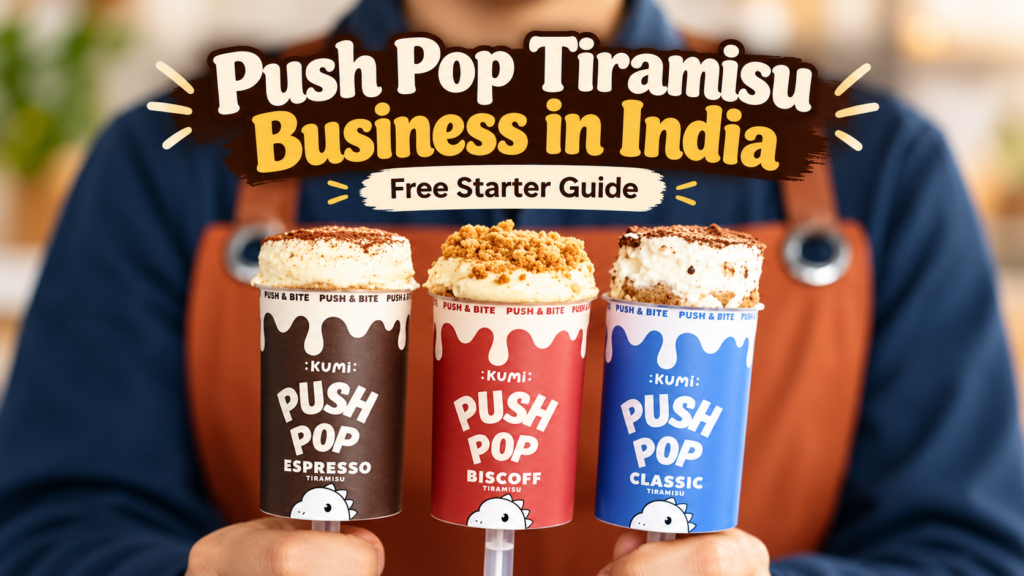
A Push Pop Tiramisu is a layered tiramisu-style dessert assembled inside a transparent push-up container. The customer pushes the base upward while eating, so each layer rises through the tube. The commercial value is not only the recipe; it is the combination of dessert + packaging format + customer interaction + visual presentation.
A typical version may include sponge or ladyfinger, coffee soak, mascarpone-based cream, whipped cream, cocoa and a garnish. Businesses can then extend the format into Biscoff, chocolate, pistachio, matcha, mango, strawberry cream, mousse, cheesecake, brownie-and-cream or other layered desserts.
2. Is there real market validation in India?
Yes—there are currently visible Indian menu examples, although this is still not evidence that every city will support the same demand or price.
- Delhi: Careme lists Classic Tiramisu Pop at ₹180, Mango Tiramisu Pop at ₹180 and Biscoff Tiramisu Pop at ₹200.
- Hyderabad: Xocolatl lists Classic Tiramisu Push Pop at ₹300 and Chocolate & Nutella Push Pop at ₹350 on current Swiggy listings.
These examples show that Indian customers are already being offered the format at roughly ₹180–₹350 in visible listings. This does not mean ₹349, ₹399 or ₹449 will work everywhere. Those higher numbers should be treated as local pricing experiments based on portion size, ingredients, brand, location and packaging.
Tamil Nadu angle: Publicly searchable examples under the exact “Push Pop Tiramisu” name appear less prominent than the Delhi and Hyderabad examples found in this research. That may create an early-adopter opportunity, but it is not proof that nobody in Tamil Nadu sells it. Do a local Instagram, Google Maps, Swiggy/Zomato and bakery check before claiming first-mover status.
3. Three practical business models
Model A — Existing café or bakery adds Push Pops
This is usually the lowest-friction route because the business may already have refrigeration, staff, delivery systems, customers and a licensed kitchen. The incremental spend is mainly packaging, ingredients, trial batches, labels, photography and launch promotion.
Model B — Home-based or cloud-kitchen dessert brand
Start with two or three flavours, produce in controlled batches, keep the product chilled and sell through pre-orders, local delivery or pickup. This avoids storefront rent, but food-safety compliance, temperature control, wastage and realistic shelf-life validation still matter.
Model C — Push Pop packaging supply business
This is the second opportunity hidden inside the trend. Instead of making tiramisu, source food-contact-suitable push-pop containers and sell them B2B to cafés, bakeries, cloud kitchens, caterers, home bakers, event businesses and dessert startups.
A beginner can start as a packaging sourcing + branding + distribution business: plain container + sticker + sleeve + optional outer box. Manufacturing a custom plastic mould from day one adds capital, tooling and technical risk and is generally better considered only after demand is proven.
4. What should you actually sell?
Do not build the entire business around only one flavour. Start narrow, then expand using the same packaging platform.
| Launch SKU | Positioning | Illustrative price test |
|---|---|---|
| Classic Tiramisu | Entry / signature | ₹199–₹249 |
| Biscoff / Chocolate | Premium familiar flavour | ₹229–₹299 |
| Pistachio / Matcha | Premium / trend-led | ₹279–₹349+ |
Important: These are testing bands, not guaranteed market prices. Your actual price must come from your portion size, ingredient cost, packaging cost, competitor set, delivery economics and customer response.
Simple costing framework
For a roughly 100–120 ml unit, calculate every cost instead of using only ingredient cost:
- Mascarpone / cream / sponge / coffee / cocoa / flavouring / garnish
- Push-pop container, lid/base, label, outer box and carry packaging
- Direct labour, electricity, refrigeration and cleaning consumables
- Wastage, failed units, damaged packaging and unsold stock
- Delivery-platform commission, discounts and local delivery where applicable
An illustrative planning range from the research model is around ₹56–₹94 per unit before fixed overheads, depending heavily on recipe and packaging. The assumed ₹8–₹15 container cost inside that model is only a planning target—not a verified supplier quote. Obtain your own written quotation before relying on it.
If a unit costs ₹80 in fully loaded variable cost and sells at ₹249, the ₹169 difference is contribution, not net profit. Rent, salaries, marketing, taxes, delivery, spoilage, equipment and administrative costs still have to be paid.
5. Packaging and supplier starting points
For the packaging route, begin by testing small quantities before committing to a large import or custom mould.
Push-pop container starting point
Chandanmal Kanhaiyalal currently markets push-up pop packaging in India and promotes pan-India supply. Their public website does not provide a dependable bulk price for this exact use, so request a quotation and samples rather than assuming a unit cost.
Dairy ingredient starting points
Professional kitchens can compare foodservice suppliers for mascarpone and whipping cream. Prices vary by brand, city, pack size, cold chain and order volume. Treat online listings as procurement benchmarks only and obtain current quotations before costing a launch batch.
Branding stack
A simple packaging ladder can be:
- Transparent push-pop + sticker
- Push-pop + premium waterproof label or belly band
- Individual printed carton
- Two-, four- or six-piece dessert box
- Event / gifting box with custom branding
This creates a separate B2B upsell opportunity because a packaging seller can offer not only the tube, but also labels, sleeves, boxes and fulfilment coordination.
6. FSSAI, food-contact packaging and shelf life
Food-contact safety is non-negotiable. A transparent plastic tube should not automatically be treated as suitable for food merely because it is sold online. Ask the supplier for the material specification, food-grade declaration, applicable food-contact compliance documentation, batch/invoice details and any migration/compliance documentation relevant to the material and use case.
FSSAI licensing update: from 1 April 2026, FSSAI revised turnover thresholds. For relevant food business categories, registration applies up to ₹1.5 crore annual turnover, State Licence above ₹1.5 crore up to ₹50 crore, and Central Licence above ₹50 crore. The correct Kind of Business and any other licensing conditions still depend on the exact operation.
Shelf life: do not print “5 days” or “7 days” simply because another tiramisu seller uses that period. Tiramisu can contain highly perishable dairy and, depending on formulation, eggs. Commercial shelf life should be established for the exact formulation, preparation method, packaging, temperature control and storage conditions. Begin conservatively and extend only after appropriate validation.
GST: restaurant service and separately sold packaged goods can have different classification consequences. Verify the exact GST treatment for your business model with a tax professional rather than copying a generic rate from another food business.
7. Practical 7-step launch plan
- Choose one model: café add-on, home/cloud kitchen, or packaging supply.
- Check local competition: search Instagram, Google Maps and delivery apps in your city; record flavours, portion size, price and packaging.
- Source samples: test two or three container types for fit, leakage, refrigerator performance, transport and ease of eating.
- Launch only 2–3 SKUs: Classic plus one mass-appeal flavour and one premium flavour is enough for the first test.
- Build a real costing sheet: include ingredients, packaging, wastage, labour, delivery/platform charges and fixed overheads.
- Run a paid validation: test 30–100 units through pre-orders, café customers or a local launch. Track paid conversion and repeat demand, not just likes and comments.
- Scale only after evidence: negotiate better packaging prices, add outer boxes, increase production and approach B2B customers only after the first model works.
Packaging-business mini plan
If you are more interested in the container than the dessert, your first offer can be:
“We help dessert businesses launch Instagram-friendly single-serve desserts without investing in custom packaging.”
Create a small sample kit with a plain push-pop tube, branded sticker version, sleeve and premium box. Show café owners what the finished customer experience looks like rather than trying to sell them an empty plastic tube.
Free validation checklist
- Have I found at least five local dessert competitors or substitutes?
- Do I have a written quote for the actual push-pop container?
- Have I checked food-contact documentation?
- Have I tested the container under refrigeration and delivery?
- Do I know the exact unit cost including wastage and packaging?
- Have I defined a conservative selling window instead of guessing shelf life?
- Have I tested whether real customers will pay the intended price?
Useful next reads on Simply Business Hub
- Double Cup Drink Business in India — sourcing, pricing and business model
- Relaxation Drink Business in India — free starter guide
- Explore more Agriculture & Food Business ideas
Sources and verification
- Careme, Delhi — current Tiramisu Pop menu pricing
- Xocolatl, Hyderabad — current Push Pop menu pricing
- FSSAI / FoSCoS — revised 2026 Kind of Business eligibility thresholds
- Chandanmal Kanhaiyalal — push-up packaging product catalogue
Want the complete Push Pop Tiramisu Business Blueprint?
Disclaimer: Educational feasibility content only. Market prices, supplier availability, regulations, tax treatment and input costs can change. Pricing bands and costing figures identified as illustrative are planning assumptions, not guarantees or supplier quotations. Food businesses should verify the exact FSSAI requirements, packaging compliance, shelf-life validation and tax treatment applicable to their operation before selling.