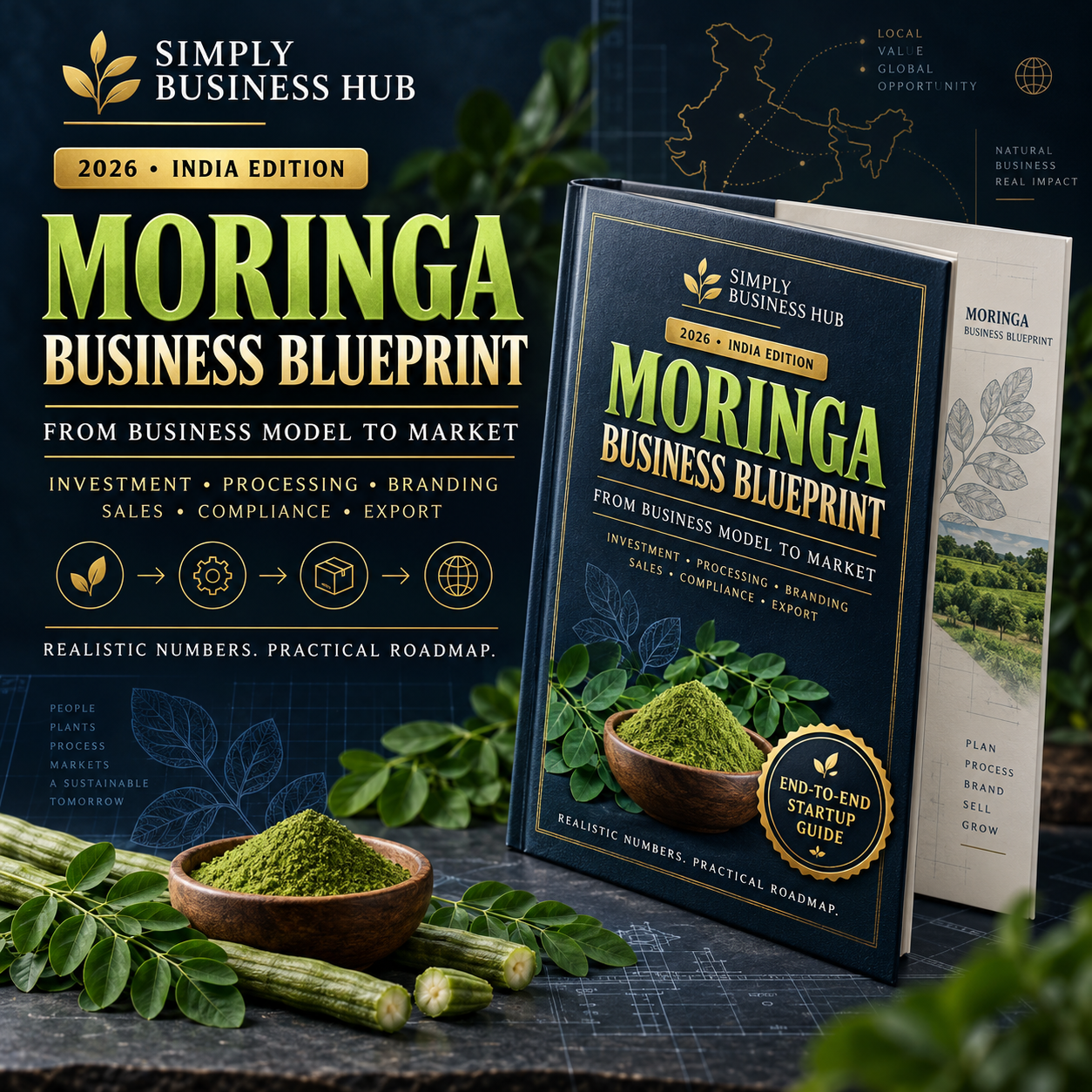
Inside This Blueprint
Build Your Moringa Business with Clarity—Not Hype
Moringa is frequently promoted as a high-profit crop or health-product opportunity. But market interest alone does not guarantee that every moringa farm, processing unit or consumer brand will succeed.
The Moringa Business Blueprint 2026 gives aspiring entrepreneurs a practical framework for evaluating, planning and launching a moringa-based business in India.
It helps you answer the most important questions before investing:
– Which moringa business model suits my capital and capabilities?
– Should I begin with farming, processing, private labelling or trading?
– How much investment could each model require?
– What equipment and operational capabilities are necessary?
– How should the product be processed, tested, packed and stored?
– Which licences and compliance areas should I investigate?
– How can I build a trustworthy consumer brand?
– How should I calculate contribution and profitability?
– Can I sell through retail, D2C, B2B or export channels?
– What should I validate before investing in land or machinery?
What the Blueprint Covers
1. Moringa Opportunity Assessment
Understand the commercial opportunity, major product categories, customer segments and practical factors influencing demand.
2. Business-Model Comparison
Compare multiple operating models:
– Fresh moringa pod farming
– Fresh-leaf supply
– Dried-leaf and powder processing
– Moringa tea and value-added products
– Private-label consumer brand
– B2B ingredient supply
– Export-oriented supply
Each model is assessed based on investment, operational difficulty, working capital, quality requirements and market access.
3. Suitability Assessment
Evaluate whether this business matches your:
– Available investment
– Location and infrastructure
– Sales capabilities
– Access to raw material
– Quality-control capacity
– Risk tolerance
– Time commitment
The blueprint also explains situations in which you should avoid or postpone the business.
4. Realistic Investment Planning
Review indicative investment ranges for farming, brand-first pilots, micro-processing operations and export-oriented models.
The estimates are planning ranges—not guaranteed quotations—and explain the factors that can increase or reduce your actual investment.
5. Processing and Equipment Guidance
Understand the typical workflow from raw-leaf sourcing to:
– Sorting and cleaning
– Controlled drying
– Milling and sieving
– Testing
– Packaging
– Batch identification
– Storage
– Finished-product dispatch
You will also learn when outsourcing may be more practical than purchasing machinery immediately.
6. Quality and Compliance Checkpoints
The blueprint introduces important areas such as:
– FSSAI applicability
– Product labelling
– Batch traceability
– Laboratory testing
– Hygiene controls
– Shelf-life validation
– Advertising and product claims
– Export documentation considerations
Compliance requirements can change. The blueprint explains what to verify with the relevant authorities and qualified professionals before commercial production.
7. Supplier and Manufacturer Evaluation
Use practical checkpoints to compare farms, raw-material suppliers, contract manufacturers, laboratories, packaging vendors and logistics providers.
8. Branding and Product Positioning
Learn how to define:
– Target customer
– Customer problem
– Product format
– Pack size
– Brand positioning
– Trust signals
– Packaging communication
– Pricing strategy
9. Sales and Marketing Strategy
Explore practical routes to market, including:
– Instagram and content marketing
– Direct-to-consumer selling
– Marketplaces
– Local retail
– Health and wellness stores
– Institutional customers
– B2B buyers
– Distributors
– Export buyers
10. Unit Economics and Profitability
Learn how to calculate the amount remaining after:
– Product cost
– Packaging
– Testing allocation
– Payment charges
– Shipping
– Marketplace commissions
– Returns
– Damaged stock
– Customer-acquisition cost
The blueprint clearly distinguishes revenue, gross margin, contribution and final net profit.
11. Pilot Launch Roadmap
Follow a structured approach:
1. Select one business model.
2. Define one target customer.
3. Interview potential buyers.
4. Qualify multiple suppliers.
5. Calculate unit economics.
6. Prepare a small compliant pilot.
7. Launch through one primary sales channel.
8. Measure customer response and contribution.
9. Improve the offer.
10. Scale only after obtaining evidence of demand.
Who Is This Blueprint For?
This guide may be useful for:
– Aspiring entrepreneurs
– Farmers exploring value addition
– Food and wellness-product founders
– Small manufacturers
– Private-label sellers
– D2C brand builders
– Traders and distributors
– Entrepreneurs investigating moringa exports
Who Should Not Purchase It?
This blueprint is not suitable for anyone expecting:
– Guaranteed profits
– Instant passive income
– A fixed return on investment
– A guaranteed export order
– A shortcut without customer research
– Personalised legal, financial or agricultural advice
What You Will Receive
– One downloadable Moringa Business Blueprint
– Approximately 20–22 professionally designed pages
– India-focused 2026 edition
– Business-model comparison
– Indicative investment planning
– Unit-economics framework
– Processing and quality guidance
– Branding and sales strategy
– Compliance checkpoints
– Pilot-launch roadmap
– Actionable checklists
Important Disclaimer
This blueprint is provided solely for educational and general business-planning purposes. It does not constitute legal, financial, tax, investment, medical, agricultural, food-safety or export advice.
All investment figures, pricing examples, margins, projections and operational assumptions are indicative illustrations. Actual results depend on location, scale, product quality, supplier terms, customer demand, competition, regulatory requirements, operating efficiency, marketing performance and other factors.
Simply Business Hub does not guarantee profits, sales, approvals, licences, funding, buyer acquisition, export orders or business success. Regulations, standards, fees and market conditions can change. Readers must independently verify current requirements with official authorities and consult qualified professionals before investing or commencing commercial operations.
Purchasing this blueprint does not create a consultancy, partnership, agency, fiduciary or advisory relationship with Simply Business Hub.
Evaluate first. Validate demand. Start small. Scale with evidence.


Reviews
There are no reviews yet.