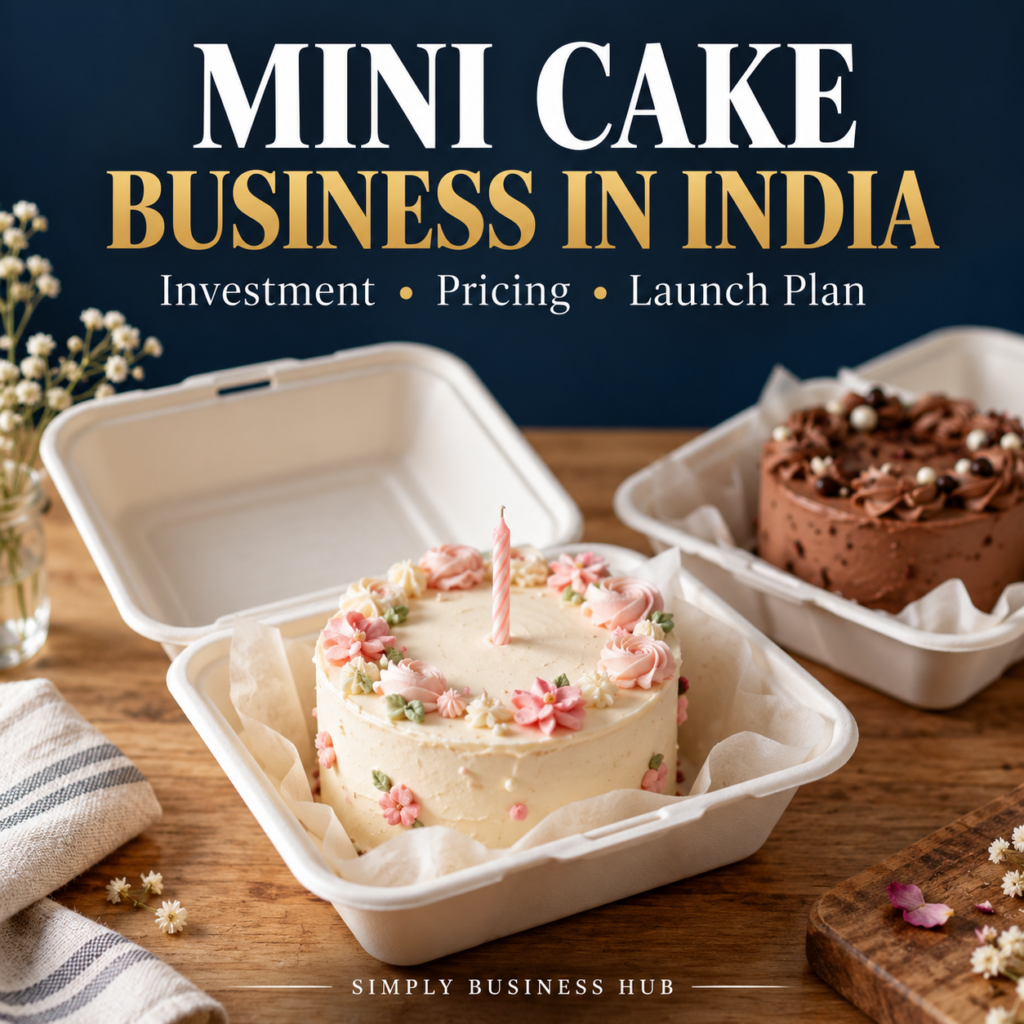
A mini cake business in India can be a practical addition to an existing home bakery or cake shop. The product serves a simple need: a small celebration cake for one or two people, with a personalised message and attractive packaging.
However, a smaller cake does not automatically mean a large profit. Decorating time, refrigeration, packaging, customer acquisition and delivery can cost more than beginners expect.
This guide explains how to test the business with a limited menu and pre-orders before investing in a shop. For a related dessert idea, see our Push Pop Tiramisu guide.
Planning basis: September 2026. Supplier and retail prices are reference points, not quotations. Investment ranges and financial scenarios are our planning estimates. Actual costs depend on your location, recipe, equipment, order volume and sales channel.
Mini cake business: a quick overview
| Question | Practical starting point |
|---|---|
| Who is it best suited to? | Existing home bakers, trained beginners and bakeries adding a product line |
| Recommended launch model | Local pre-orders with scheduled pickup or chilled delivery |
| Initial product | Small celebration cakes in clearly stated weights, with different flavours and designs |
| Existing baker’s pilot budget | Approximately ₹10,000–₹20,000 |
| Home setup with existing refrigerator | Approximately ₹30,000–₹54,000 |
| Suggested price tests | ₹349–₹449 for simple designs; higher for premium ingredients or detailed work |
| Main challenge | Maintaining taste, decoration quality and delivery reliability while charging for labour |
| First milestone | Complete 20 paid orders and measure actual costs and customer feedback |
These are starting assumptions to test, not a guarantee of demand.
1. What are mini celebration cakes?
Mini cakes are small-format cakes offered in different sizes, flavours, shapes and designs. They can be individual desserts or personalised cakes for a small celebration. There is no single universal weight, design or packaging format that defines every mini cake.
A bakery can offer individual mini cakes, two-person celebration cakes and slightly larger small-group cakes. Publish the finished weight and serving guidance for each product rather than using the word mini alone.
This guide focuses on the broader mini cake business. Lunchbox-style cakes are only one possible format; a mini cake can also be served on a plate or packed in a suitable cake box or dome.
Small cakes are sold in many countries. We do not attribute the entire mini cake category to South Korea. The business opportunity is to provide a personalised cake in a suitable portion size, with reliable taste, presentation and service.
Mini cakes already exist in India. Test local demand rather than relying on a first-mover claim.
2. What customer problem does this solve?
Someone celebrating an anniversary, birthday, new job or promotion with one other person may prefer a small cake over a larger one.
The product can offer:
– A smaller portion with fewer leftovers.
– A personalised celebration experience.
– Convenient gift packaging.
– A manageable total purchase price.
– A product that photographs well.
These benefits create a reason to buy. They do not establish that demand will be high in every locality.
Compare your product with local half-kilogram cakes, cupcakes, brownies and dessert boxes. If a larger cake costs only slightly more, customers need a clear reason to choose your mini cake.
3. Who should start this business?
| Entrepreneur | Suitability | What to check first |
|---|---|---|
| Existing home baker | Strong fit for a small pilot | Spare oven time, refrigerator space and actual customer interest |
| Existing bakery | Suitable as an additional menu category | Whether it adds sales or replaces more profitable orders |
| Trained beginner | Possible after recipe and decoration practice | Consistent results across multiple batches |
| Café owner | Possible as a celebration or takeaway offering | Refrigerated storage, stock turnover and unsold inventory |
| Complete beginner seeking immediate income | Poor fit without preparation | Baking skills, food safety and willingness to handle service issues |
A home-based model suits someone who can manage time-sensitive orders, maintain a hygienic workspace and communicate clearly with customers.
If your employment restricts outside business activities, check those rules before taking orders.
4. Start with a small menu
Launch with three flavours, a few repeatable designs and a choice of small sizes. The following weights, servings and prices are illustrative options to test, not a universal definition of mini cake.
| Product | Finished weight and serving guide | Indicative price test |
|---|---|---|
| Individual mini cake | 120–150 g; approximately one serving | ₹179–₹249 |
| Small celebration cake | 200–250 g; approximately one to two servings | ₹299–₹399 |
| Sharing mini cake | 300–350 g; approximately two to three servings | ₹399–₹549 |
| Premium mini cake | Size selected by customer; costlier filling or detailed design | Quote from recipe, weight and decorating time |
These are proposed test prices, not verified selling prices for every town.
For a related small-cake price reference, Bakingo’s listings checked during research showed 300 g cakes marketed in its lunchbox-style range at ₹399 and ₹419, inclusive of GST. These are comparison products, not a definition of the broader mini cake category. Prices, delivery availability and offers can change.
State the finished cake weight. Diameter alone does not tell customers how much cake they are buying. A 250–300 g cake may suit two modest servings, but appetite and recipe density vary.
Keep the initial offer simple:
– Two or three clearly specified sizes using shared recipes and repeatable designs.
– Three flavours.
– Three decoration styles.
– One short personalised message.
– A clearly stated order deadline.
– Delivery charged separately.
Detailed illustrations, premium toppings and elaborate packaging should have separate prices.
5. Investment: how much money is needed?
Option A: existing home baker
If you already have a suitable oven, mixer, refrigerator and basic tools, budget approximately ₹10,000–₹20,000 for an initial pilot.
This can cover practice batches, a few additional tools, packaging, photographs, hygiene supplies and working capital.
Do not buy a second oven or rent a shop before proving that paid orders exist.
Option B: home setup with an existing refrigerator
| Item | Planning allowance |
|---|---|
| Suitable OTG or baking oven | ₹7,000–₹12,000 |
| Hand mixer | ₹2,000–₹4,000 |
| Digital scale and thermometers | ₹1,000–₹2,000 |
| Pans, cooling racks, turntable and decorating tools | ₹3,000–₹5,000 |
| Storage containers and sanitation supplies | ₹2,000–₹4,000 |
| Ingredients for trials and opening batches | ₹3,000–₹6,000 |
| Initial packaging stock | ₹1,500–₹3,000 |
| Compliance and administration allowance | ₹1,500–₹3,000 |
| Basic photography and launch marketing | ₹1,000–₹3,000 |
| Working capital and contingency | ₹8,000–₹12,000 |
| Total | ₹30,000–₹54,000 |
The compliance allowance is a budgeting provision, not a quoted government fee.
As an equipment reference, Borosil’s official OTG collection page listed a Prima Pro 30 L model at ₹7,890 when checked. Verify the current price, tray dimensions, electrical requirements, warranty and suitability for your intended usage.
If you need an additional refrigerator, allow approximately ₹18,000–₹30,000 extra, subject to local quotations. This takes the illustrative budget to about ₹48,000–₹84,000.
These budgets assume a usable home kitchen. They exclude shop rent, rental deposits, major renovation, air conditioning and full-time employees.
A commercial shop needs a separate location-specific budget.
6. Equipment, ingredients and sourcing
Essential equipment includes an oven, mixer, accurate scale, cake pans, cooling racks, decorating tools, food-safe storage containers and suitable refrigeration.
Use a refrigerator thermometer rather than assuming the appliance setting reflects the actual temperature.
For ingredients, source consistent flour, sugar, fats, chocolate or cocoa, dairy products, fillings and permitted colours from reputable suppliers. Retain invoices and record expiry dates.
For packaging:
– Test cake-board fit and lid clearance.
– Check food-contact suitability.
– Keep candles and accessories separately wrapped.
– Test whether the cake moves during transport.
– Include storage instructions and applicable product information.
Choose packaging to suit each cake: a food-safe box and board, a suitable dome, or a compact takeaway container. One compact-container supplier listing checked during research offered 25 boxes for ₹250, or ₹10 per empty box, before additional delivery cost. This is only one packaging option and is not suitable for every size or design. Boards, liners, labels, bags and accessories must also be costed.
Compare at least three local or online suppliers. Buy samples before placing a bulk order.
7. How to calculate the cost of one mini cake
Cost the finished saleable cake, including failed batches and your time.
Here is an illustrative ₹449 direct-order model for one approximately 250–300 g decorated mini cake. This single-product example does not represent the costs or margins of every size, flavour or design:
| Cost component | Assumed cost per cake |
|---|---|
| Sponge, filling, frosting and simple decoration | ₹110 |
| Box, board, liner, label and accessory allowance | ₹35 |
| Variable electricity and water | ₹15 |
| Owner production labour | ₹60 |
| Wastage and remake allowance | ₹15 |
| Payment processing and order consumables | ₹15 |
| Total variable cost | ₹250 |
| Selling price | ₹449 |
| Contribution toward overhead and profit | ₹199 |
The ₹60 labour provision assumes approximately 30 minutes of active production work at ₹120 per hour. Measure your own batch preparation, decoration and cleaning time.
Order administration and content creation also take time. Account for them when deciding whether the business is worthwhile.
The ₹110 ingredient figure is a model assumption, not a universal recipe cost. Replace it with your actual ingredient consumption and supplier prices.
Recipe costing method:
Ingredient cost = quantity used × purchase cost per gram or millilitre.
Add the ingredient costs for the batch, then divide by the number of saleable cakes produced. Record batch yield and finished weight.
The ₹199 contribution is not net profit. Monthly overhead still needs to be paid.
8. Pricing strategy that protects your margin
Use this formula:
Selling price = variable cost + overhead allocation + target profit.
At 60 cakes a month with ₹6,000 monthly overhead:
– Variable cost: ₹250 per cake.
– Overhead allocation: ₹100 per cake.
– Remaining operating profit at a ₹449 price: ₹99 per cake.
At only 30 cakes a month, the same overhead allocation rises to ₹200 per cake. A ₹449 selling price would barely cover the modelled total cost.
This is why copying another bakery’s price can be risky.
Set clear charges
| Order feature | Pricing approach |
|---|---|
| Standard short message | Include within a stated character limit |
| Premium filling | Charge for extra ingredients and wastage |
| Detailed illustration | Charge for additional design time |
| Gift packaging | Add actual packaging cost and a margin |
| Rush order | Accept only if capacity permits; state the surcharge |
| Delivery | Quote separately based on the actual route and handling needs |
Avoid permanent launch discounts. In this model, reducing the price from ₹449 to ₹399 cuts contribution from ₹199 to ₹149.
The financial examples assume a small direct seller that is not charging output GST. Input taxes are included in purchase costs. If GST applies to your business, calculate revenue net of the applicable output tax and review input-credit treatment with an accountant.
9. Realistic monthly revenue and profit scenarios
Assume:
– Selling price: ₹449 per cake.
– Variable cost: ₹250, including owner production labour.
– Monthly overhead: ₹6,000.
– Delivery recovered separately from customers.
– No commercial shop rent or full-time employee.
The ₹6,000 overhead is an illustrative allowance for shared kitchen costs, basic marketing, administration, cleaning, maintenance and equipment depreciation. Replace it with your actual expenses.
| Cakes sold monthly | Sales revenue | Variable costs | Overhead | Operating result |
|---|---|---|---|---|
| 30 | ₹13,470 | ₹7,500 | ₹6,000 | ₹30 loss |
| 60 | ₹26,940 | ₹15,000 | ₹6,000 | ₹5,940 profit |
| 120 | ₹53,880 | ₹30,000 | ₹6,000 | ₹17,880 profit |
| 180 | ₹80,820 | ₹45,000 | ₹6,000 | ₹29,820 profit |
These are arithmetic scenarios, not sales forecasts. The operating results are before income tax and loan interest.
The higher volumes require reliable demand and adequate production, refrigeration and delivery capacity. Overhead may increase as the business grows.
Break-even visual
₹449 selling price − ₹250 variable cost = ₹199 contribution
₹6,000 overhead ÷ ₹199 contribution = 30.15
Therefore, the model needs 31 cakes a month to break even.
| Selling price | Contribution per cake | Cakes needed to cover ₹6,000 overhead |
|---|---|---|
| ₹399 | ₹149 | 41 |
| ₹449 | ₹199 | 31 |
| ₹499 | ₹249 | 25 |
This comparison holds variable cost constant. A premium cake may also cost more to produce.
Two costs that can change the result
If you absorb ₹70 delivery on a ₹449 cake, contribution falls from ₹199 to ₹129.
If an aggregator deducts an illustrative 25% of the selling price, contribution falls to approximately ₹87 before other platform charges, advertising or seller-funded discounts. The 25% is a sensitivity assumption, not a quotation from a platform.
For a beginner, direct pre-orders are usually easier to evaluate.
10. Production and order workflow
Enquiry → specification → payment → production → quality check → chilled storage → pickup or delivery → feedback
Capture these details before confirming an order:
– Flavour and finished weight.
– Egg or eggless preference.
– Design reference and exact message.
– Relevant allergen information.
– Required date and time.
– Pickup or delivery details.
– Total price and payment status.
Start with a 24–48-hour advance-order policy and limited daily slots.
Use standard recipes with ingredients measured by weight. Cool the sponge correctly before frosting. Check the finished weight, spelling, decoration and package fit before dispatch.
For beginners, start with two to four cakes per production day and increase only after measuring actual working time and refrigerator capacity. This is a suggested test limit, not an equipment output guarantee.
Set out cancellation, rescheduling, damage and refund policies before payment.
11. Food safety, registration and delivery
A home kitchen selling cakes is still a food business. Use the official FoSCoS portal to determine the registration or licence applicable to your activity.
FSSAI’s March 2026 announcement stated that, from 1 April 2026, the turnover threshold for registration increased to ₹1.5 crore, with State licensing up to ₹50 crore and Central licensing beyond that. Confirm the current eligibility criteria and activity classification in FoSCoS; turnover alone may not settle every case.
Also check local municipal permissions, home-premises restrictions and applicable business requirements.
Essential operating controls
– Use potable water and clean food-contact surfaces.
– Separate raw ingredients from ready-to-eat cake.
– Keep supplier, batch and cleaning records.
– Use food-safe colours, decorations and packaging.
– Clearly communicate relevant allergens such as wheat, milk, eggs, soy or nuts.
– Follow applicable labelling and display requirements.
– Use appropriate chilled storage for perishable frostings and fillings.
For a cream-based pilot, design operations around refrigeration at approximately 5°C or below, consistent with relevant FSSAI cold-food guidance. Confirm recipe-specific storage requirements.
Do not promise a generic three-day or five-day shelf life. Establish a defensible use-by period for your recipe, handling and storage conditions with qualified advice and testing where needed.
Begin with a small delivery radius, such as two to five kilometres, and test the route, packaging and temperature control. Distance alone does not establish safe delivery.
Fresh cream cakes are unsuitable for ordinary parcel shipping without an appropriate validated cold chain.
GST obligations depend on the nature of supplies, location, turnover and sales arrangements. Check these before expanding or joining an aggregator.
12. Marketing strategies for local paid orders
Instagram: show the actual product
Create content that answers purchase questions:
– Show the cake beside a hand or plate to communicate size.
– Show the finished packaging.
– Display the weight, starting price and service area.
– Film a short personalisation sequence.
– Show flavour choices and ordering deadlines.
Use genuine customer photographs or feedback with permission. Never fabricate reviews.
Customers may share an attractive cake on Instagram, creating additional exposure. Treat that as a possible benefit, not guaranteed free marketing.
WhatsApp Business: make ordering easy
Create a catalogue with product photographs, prices, serving guidance and advance-order requirements.
Use labels for enquiries, confirmed orders, production, delivery and follow-up. Keep customer messages accurate and consent-based.
Local partnerships
Test relationships with florists, gift shops, photographers and celebration planners. Agree any referral fee in advance and include it in the order’s profitability calculation.
Small paid-ad test
After obtaining genuine product feedback, consider a ₹1,000–₹2,000 local advertising test.
Measure paid orders, not views or likes.
If ₹1,500 of advertising brings ten new paying customers, acquisition cost is ₹150 per customer. In the ₹199 contribution model, that leaves only ₹49 toward overhead on the first order.
Repeat orders can improve the economics, but they must be measured.
13. A practical 30-day launch plan
| Period | Actions | Evidence to collect |
|---|---|---|
| Days 1–7 | Check competitors, complete compliance checks, practise three flavours and test packaging | Supplier quotations, recipe costs and consistent finished weights |
| Days 8–14 | Publish a simple catalogue and seek the first five paid orders | Customer willingness to pay and delivery performance |
| Days 15–21 | Work toward 20 total paid orders with limited daily slots | Actual labour, contribution, complaints and acquisition cost |
| Days 22–30 | Review results and improve the menu | Whether customers buy again, refer others or accept profitable prices |
Twenty paid orders are a learning milestone, not proof of long-term demand.
Continue only if the product can be sold at a price that pays for ingredients, labour and overhead. If customers respond only to deep discounts, change the offer or pause expansion.
14. Risks and ways to reduce them
| Risk | Practical response |
|---|---|
| Price resistance | Compare local alternatives and simplify the design |
| Excess decoration time | Offer a fixed design catalogue with priced upgrades |
| Unsold stock | Use pre-orders and small ingredient purchases |
| Delivery damage or heat exposure | Test chilled handling, package fit and routes |
| Inconsistent taste | Standardise recipes and record batch results |
| Too many enquiries but few orders | Make price, size and ordering steps clear |
| Seasonal order spikes | Cap slots and avoid unrealistic delivery promises |
| Low profit despite good revenue | Track labour, discounts, delivery and marketing costs |
Frequently asked questions
Can I start a mini cake business from home?
Yes, if your premises, food-business registration or licensing and local requirements permit it. You also need suitable hygiene controls and refrigeration.
Can I start with ₹10,000?
An existing baker may run a limited pilot around that budget if the essential equipment is already available. It is not a realistic full setup budget for someone starting without equipment.
How much should I charge?
Test simple cakes around ₹349–₹449 only if your actual costing supports those prices. Premium recipes and detailed designs require higher prices.
Is this a new business in India?
No. Mini cakes in various sizes and styles are already sold in India. Your opportunity is to serve a local customer segment well with suitable portions, flavours, designs and reliable service.
How much profit can I earn?
There is no fixed earning figure. In the illustrative ₹449 model, 60 cakes a month produce ₹5,940 operating profit after the stated costs, including owner production labour. Actual results can be lower or negative.
Should I open a shop immediately?
Validate paid demand through a home or existing-bakery pilot first. Rent and staffing substantially change break-even.
Our recommendation
Start with three flavours, simple personalisation and advance orders. Measure 20 paid orders before expanding the menu or buying more equipment.
The business becomes attractive when customers consistently accept a price that covers your time, food safety, packaging and service—not merely when a reel gets attention.
தமிழில்: முதல்ல small pre-order model-ல test பண்ணுங்க. வெவ்வேறு sizes, flavours, designs offer பண்ணலாம். Ingredients மட்டும் இல்லாம உங்க நேரம், packaging, delivery, marketing செலவையும் சேர்த்து price பண்ணுங்க.
Sources and further reading
Research reference date: September 2026. Supplier prices and regulatory requirements can change.
Bakingo small-cake price references: https://www.bakingo.com/p/bento-cakes/strawberry-milk-chocolate-bento-cake-cake3619stra and https://www.bakingo.com/p/bento-cakes/milk-choco-bento-cake-300gm-bento5667
Borosil official oven range: https://myborosil.com/collections/oven-toaster-griller?type=17039
Example compact cake packaging: https://thebakingtools.com/products/bento-cake-box-burger-box-pack-of-25
FSSAI March 2026 reforms: https://www.fssai.gov.in/upload/uploadfiles/files/Press%20Release_FSSAI%20Reforms_130326.pdf
Official food-business applications: https://foscos.fssai.gov.in/
FSSAI bakery food safety manual: https://fostac.fssai.gov.in/doc/Traning%20Manual_Bakery%20%20Level%202.pdf
FSSAI labelling and display regulations: https://www.fssai.gov.in/upload/uploadfiles/files/Comp_Labelling%20Display_Version%20VII_03042025.pdf
Concept inspiration: Lafayette by Mug Cakes, Chennai. Independent business analysis; no commercial affiliation is implied.
Explore more Business Ideas: https://simplybusinesshub.in/category/business-ideas/
Disclaimer: This guide provides educational planning information. Budgets, suggested prices and profit examples are estimates, not supplier quotations or promised returns. Verify local costs, regulatory requirements and product safety before launching.