Indoor Mushroom Farming Business in India (2026 Guide) 🍄
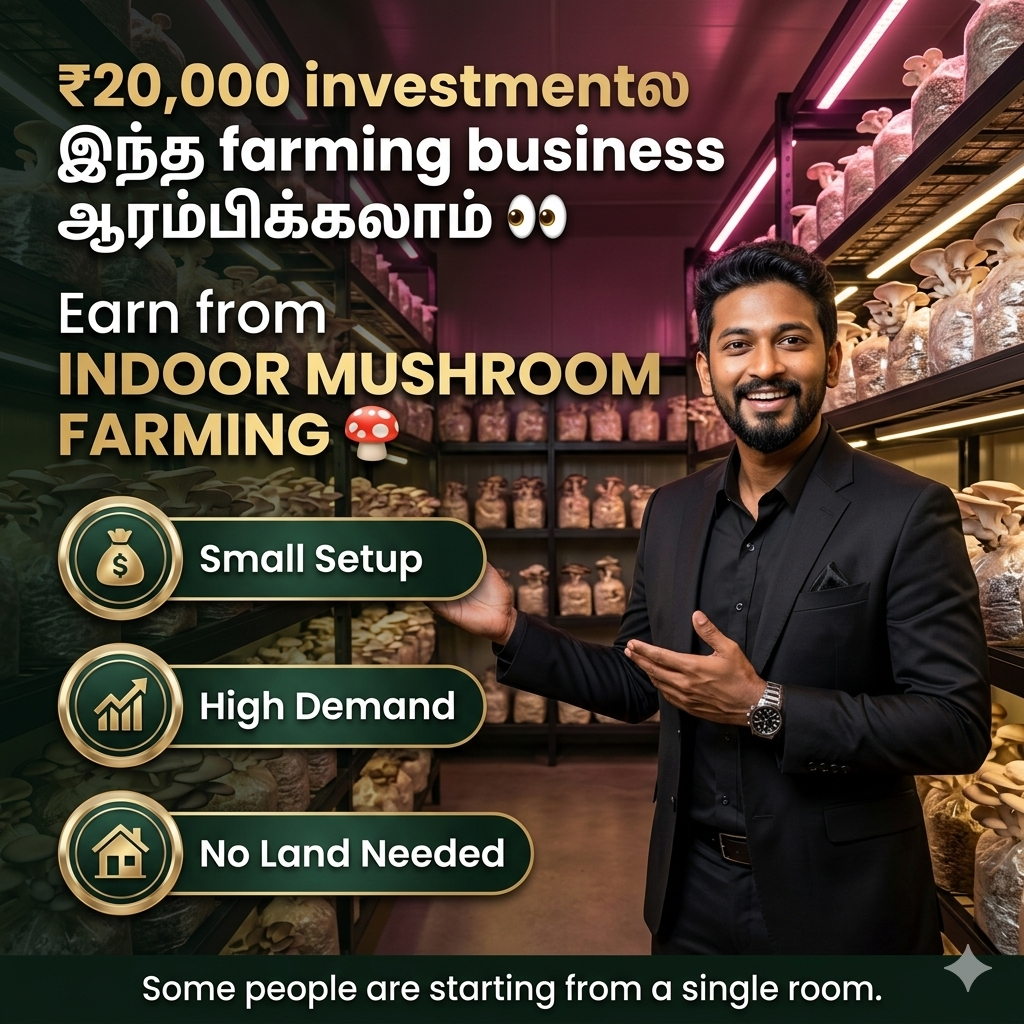
Indoor mushroom farming is becoming a practical low-investment agriculture business idea in India. Many beginners, students, women entrepreneurs, and small farmers are now starting mushroom cultivation from small rooms, sheds, terraces, and unused spaces.
Unlike traditional farming, mushroom farming requires:
✅ Less land
✅ Less water
✅ Small investment
✅ Short crop cycle
✅ High market demand
Because of increasing demand for healthy food, organic products, protein-rich diets, and fresh farm produce, the mushroom business in India is growing rapidly in Tier 2 and Tier 3 cities.
Why Indoor Mushroom Farming is Growing Fast in India 📈
The mushroom farming business is gaining popularity because:
-
Restaurants and hotels regularly buy fresh mushrooms
-
Swiggy Instamart, Blinkit, and supermarkets now sell mushrooms daily
-
Health-conscious consumers are increasing
-
Mushrooms are considered high-protein healthy food
-
Farming can be done indoors throughout the year
-
Fast harvest cycle compared to traditional crops
Some small entrepreneurs use mushroom cultivation as a side business, but results depend on production quality, hygiene, pricing and access to buyers.
Best Mushroom Types for Beginners 🍄
1. Oyster Mushroom (Best for Beginners)
This is the easiest and most beginner-friendly mushroom.
Advantages:
✅ Low investment
✅ Faster growth
✅ Less maintenance
✅ Suitable for warm Indian climate
Selling Price:
₹120–₹220 per kg depending on city and quality.
2. Button Mushroom
The most commonly consumed mushroom in India.
Advantages:
✅ High demand
✅ Easily sold in supermarkets
✅ Popular among restaurants
Challenge:
Needs temperature-controlled environment.
Selling Price:
₹140–₹250 per kg.
3. Milky Mushroom
Very suitable for South Indian climate.
Advantages:
✅ Good shelf life
✅ Works well in warmer regions
✅ Attractive market value
Selling Price:
₹180–₹300 per kg.
4. Shiitake Mushroom
Premium category mushroom.
Advantages:
✅ Premium-market pricing potential
✅ Premium health market
✅ Used in hotels and specialty stores
Challenge:
Advanced cultivation knowledge required.
Selling Price:
₹800–₹2000 per kg.
Space Required for Mushroom Farming 🏠
One major advantage is that mushroom farming does NOT require agricultural land.
You can start from:
-
Small room
-
Terrace room
-
Shed
-
Garage
-
Unused shop
-
Container room
Even a 10×10 room can be enough for a starter setup.
Basic Equipment Required ⚙️
Starter Setup Materials
Essential Items:
-
Mushroom grow bags
-
Racks or shelves
-
Mushroom spawn
-
Straw or compost
-
Water sprayer
-
Humidity control
-
Thermometer
-
Plastic sheets
-
Small exhaust fan
Investment Breakdown 💰
Small Beginner Setup (₹20,000–₹50,000)
Suitable for learning and small-scale selling.
Includes:
-
Basic racks
-
50–100 grow bags
-
Spawn purchase
-
Humidity setup
-
Basic lighting
Possible Yield:
Approx. 60–120 kg per cycle.
Possible Revenue:
₹8,000–₹25,000 per cycle depending on mushroom type and selling price.
Medium Scale Setup (₹1–₹3 Lakhs)
Suitable for serious business operation.
Includes:
-
Dedicated grow room
-
Multiple rack systems
-
Better humidity control
-
Packaging setup
-
Increased production capacity
Possible Yield:
300–800 kg per month.
Possible Revenue:
₹60,000–₹2 Lakhs monthly depending on sales channel.
Commercial Mushroom Farm (₹5 Lakhs+)
Large-scale commercial operation.
Includes:
-
Climate-controlled rooms
-
Commercial racks
-
Cold storage
-
Branding and packaging
-
Labour and logistics
Possible Revenue:
₹3–₹10 Lakhs monthly in large operations with proper distribution.
Important Reality Check ⚠️
Mushroom farming is NOT “easy money.”
Success depends on:
-
Hygiene
-
Temperature control
-
Humidity management
-
Quality spawn
-
Consistent monitoring
-
Proper selling channels
Beginners should START SMALL first.
Learn → Test → Improve → Scale.
Crop Cycle & Harvest Time ⏳
One reason mushroom farming attracts entrepreneurs is the short crop cycle.
Oyster Mushroom:
Harvest starts within 20–30 days.
Multiple harvest flushes are possible from one bag.
This makes mushroom cultivation faster compared to many traditional farming businesses.
Where to Sell Mushrooms 🛒
Local Selling Options:
✅ Vegetable shops
✅ Supermarkets
✅ Hotels
✅ Restaurants
✅ Organic stores
✅ Farmers markets
✅ Apartment communities
✅ Direct WhatsApp orders
Value Addition Opportunities 📦
Many mushroom farmers increase profits through:
-
Mushroom powder
-
Mushroom pickle
-
Dried mushrooms
-
Branded packaging
-
Organic product selling
-
Subscription vegetable delivery
This helps create a premium brand instead of only selling raw produce.
Training & Learning Resources 🎓
Before investing heavily, get basic training.
Good Learning Sources:
-
Krishi Vigyan Kendras (KVKs)
-
Agricultural universities
-
YouTube practical tutorials
-
Local mushroom farms
-
Government agriculture departments
Some states also provide:
✅ Subsidies
✅ Loans
✅ Entrepreneurship support
✅ Farming guidance programs
Common Mistakes Beginners Make ❌
-
Starting too big initially
-
Poor hygiene
-
Wrong humidity levels
-
Cheap low-quality spawn
-
No market planning
-
No customer network
Avoid these mistakes to improve survival chances.
Who Can Start This Business?
Indoor mushroom farming is suitable for:
✅ Students
✅ Women entrepreneurs
✅ Village startups
✅ Small farmers
✅ Home-based businesses
✅ Side hustle seekers
✅ Organic food startups
Final Thoughts 🍄
Indoor mushroom farming is one of the most practical low investment farming business ideas in India right now.
It is:
✅ Scalable
✅ Beginner-friendly
✅ Space-efficient
✅ Fast-growing industry
But success comes from:
-
Consistency
-
Learning
-
Market building
-
Gradual scaling
Start small.
Understand the process.
Build local demand.
Then scale professionally.
That’s how many successful mushroom entrepreneurs grow today.
Disclaimer: Investment, income, and profit figures mentioned are approximate industry estimates and may vary based on location, mushroom type, production quality, market demand, and business execution. Please do your own research and start small before scaling.