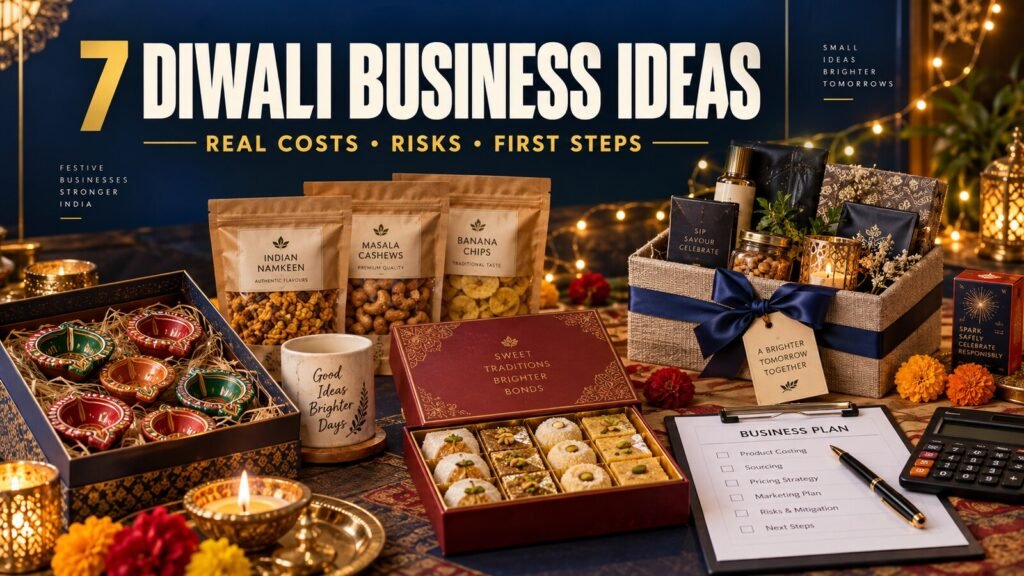
Looking for a practical Diwali business idea in India? This starter guide explains seven seasonal opportunities, their basic operating models, realistic planning ranges, major risks, compliance questions and the first steps to validate demand before investing.
Diwali falls on 8 November 2026. A seasonal business has a short selling window, so the goal should not be to launch seven products at once. The smarter approach is to select one model, create a small sample, test it with real buyers and expand only after receiving genuine enquiries or paid orders.
Important: The figures below are planning illustrations—not promised investment levels, sales, margins or profits. Actual costs depend on your city, product quality, supplier, packaging, sales channel and delivery method.
Seven Diwali Business Ideas at a Glance
| Business idea | Actual model | Indicative pilot range | Main challenge |
|---|---|---|---|
| Designer diya gift sets | Craft production and assembly | ₹15,000–₹60,000 | Finishing, breakage and packaging |
| Personalised festive gifts | Customisation; outsource-first recommended | ₹25,000–₹75,000 | Errors, remakes and delivery deadlines |
| Regional Diwali snack boxes | Food manufacturing, repacking or curation | ₹30,000–₹1,00,000 for a controlled pilot | Food safety, shelf life and freshness |
| Decorative-light installation | Service and equipment rental | ₹90,000–₹3,00,000 | Electrical safety and asset utilisation |
| Modern festive sweets | Food manufacturing or contract production | ₹50,000–₹1,50,000 for a pilot | Perishability, temperature and quality control |
| Corporate Diwali gift boxes | B2B sourcing, assembly and fulfilment | ₹25,000–₹1,00,000 plus order working capital | Payment terms and bulk fulfilment |
| Licensed firecracker resale | Regulated seasonal trading | Cannot be responsibly generalised | Licensing, premises, safety and local restrictions |
How to Calculate Whether a Diwali Business Can Work
Do not judge an opportunity from the difference between raw-material cost and selling price. Calculate the contribution from every unit:
Net selling price
– materials or purchased products
– packaging
– direct labour
– payment or marketplace fees
– delivery subsidy
– expected rejects, damage and returns
= contribution per unit
Break-even units are calculated by dividing fixed pilot expenditure by contribution per unit. Even this is not final net profit: rent, owner salary, tax, interest, unsold stock and other overheads may remain.
1. Designer Diya Gift Set Business
Instead of selling individual plain diyas, this model turns them into a ready-to-gift product through painting, decoration, coordinated colours and premium packaging. It is one of the easier Diwali manufacturing ideas to test on a small scale because samples can be created without buying expensive machinery.
A sensible beginner model
- Launch only three designs: traditional, contemporary and corporate-neutral.
- Offer four-diya and six-diya sets instead of many sizes.
- Test packaging for breakage before accepting distant orders.
- Photograph actual samples rather than using reference images from another seller.
- Take pre-orders before producing a large quantity.
Illustrative four-diya set
| Plain diyas | ₹28 |
| Paint and decorative materials | ₹24 |
| Direct labour | ₹45 |
| Gift box and filler | ₹70 |
| Labels, payment cost and wastage allowance | ₹25 |
| Illustrative variable cost | ₹192 |
| Illustrative selling price | ₹349 |
| Contribution before delivery | ₹157 |
If free delivery costs ₹70, the contribution falls to ₹87. This is why packaging and shipping cannot be ignored while pricing diya gift sets.
Primary risks: inconsistent finishing, paint flaking, high labour time, breakage and unsold design inventory.
2. Personalised Festive Gift Business
Personalised lamps, bottles, mugs, desk accessories, name plates and employee gifts can be sold to individual customers and companies. For a first seasonal launch, outsourcing production is usually safer than immediately purchasing a laser, UV printer or other expensive machine.
Recommended workflow
- Receive the name, photograph, logo or message.
- Prepare a digital mock-up.
- Obtain written customer approval for spelling and design.
- Collect full or substantial advance payment.
- Send the approved file to the production partner.
- Inspect the finished item before packing and dispatch.
An outsourced personalised acrylic lamp sold at an illustrative ₹999 might carry approximately ₹615 in product, design, packaging, payment and remake costs. That leaves an illustrative contribution of ₹384 before delivery and business overheads. The calculation must be rebuilt using actual supplier quotations.
Primary risks: spelling mistakes, low-resolution artwork, unauthorised logo or character usage, machine delays, remakes and customised products that cannot be resold.
3. Regional Diwali Snack Box Business
Regional snack boxes can combine products such as murukku, mixture, chakli, chivda, thattai, seedai or other locally familiar festive snacks. But sellers must first choose the operating model:
- Manufacturing: you make and pack the snacks.
- Repacking: you purchase bulk food and repack it.
- Contract manufacturing: a licensed producer makes products for your brand.
- Curation: you assemble sealed products sourced from licensed producers.
Each model can create different FSSAI, label, hygiene and traceability responsibilities. A contract manufacturer does not automatically remove every obligation of the brand owner or marketer.
Illustrative 500-gram snack box
| Ingredients and cooking oil | ₹155 |
| Direct labour and fuel | ₹45 |
| Food-safe primary packs | ₹32 |
| Outer gift box | ₹75 |
| QC, wastage and payment allowance | ₹43 |
| Illustrative variable cost | ₹350 |
| Illustrative selling price | ₹599 |
| Contribution before delivery | ₹249 |
Non-negotiable controls: approved ingredient suppliers, oil management, standard recipes, allergen identification, cooling before packing, seal checks, batch records, retained samples, suitable storage and a realistic dispatch cut-off.
Never copy another brand’s shelf life. Shelf life depends on the actual formulation, process, packaging and storage conditions.
4. Decorative-Light Installation and Rental
This is a service and rental business—not a home manufacturing business. The entrepreneur purchases reusable lighting inventory and charges for design, installation, rental, removal and sometimes maintenance.
A project must be priced using labour, transport, consumables, repair allowance, equipment depreciation and removal cost. For example, an ₹18,000 project with ₹12,000 in direct project costs leaves ₹6,000 contribution—not ₹18,000 profit.
What a professional setup needs
- Commercial-quality lights and cables
- Suitable circuit protection and weatherproof connections
- Load assessment and safe attachment plan
- Trained installation team
- Ladder and working-at-height safety
- Written installation and removal scope
- Asset inventory, damage terms and customer deposit policy
- Licensed electrical personnel where required
Primary risks: electric shock, fire, falls, property damage, rain exposure, overloaded circuits, underpriced labour and low utilisation of purchased inventory.
5. Modern Festive Sweet Manufacturing
Modern festive sweets may include date-and-nut bites, chocolate-coated mithai, millet-based products, flavoured laddus or premium assortments. Attractive presentation can support premium positioning, but the business carries more production and shelf-life risk than dry gift products.
Illustrative 500-gram premium assortment
| Ingredients | ₹320 |
| Labour and utilities | ₹70 |
| Packaging | ₹120 |
| QC, wastage and payment allowance | ₹82 |
| Illustrative variable cost | ₹592 |
| Illustrative selling price | ₹899 |
| Contribution before delivery | ₹307 |
The seller must control ingredient quality, allergen cross-contact, batch consistency, dairy or chocolate temperature exposure, packing hygiene and dispatch timing. Claims such as “healthy”, “sugar-free” or “diabetic-friendly” should not be used casually.
Primary risks: short shelf life, microbial contamination, melting or bloom, nut-price volatility, attractive packaging consuming the margin and overproduction near the festival.
6. Corporate Diwali Gift Box Business
Corporate gifting is mainly a B2B sourcing and fulfilment business. The seller develops samples, approaches companies, prepares quotations, collects an advance, sources products, adds approved branding, assembles boxes and delivers the completed order.
Illustrative 100-box order
| Component per box | Planning amount |
|---|---|
| Products | ₹430 |
| Outer box and filler | ₹115 |
| Branding and customisation | ₹40 |
| Assembly and quality control | ₹35 |
| Local freight and contingency | ₹60 |
| Illustrative variable cost | ₹680 |
| Illustrative selling price | ₹899 |
| Contribution per box | ₹219 |
At 100 boxes, the illustrative contribution is ₹21,900 before sample costs, selling time, GST, overheads, rejected branding and delayed-payment costs.
Documents to use
- Written quotation and purchase order
- Approved sample or product schedule
- Branding and artwork approval
- Substitution policy
- Advance and balance-payment terms
- Delivery-address confirmation
- Damage and shortage policy
Primary risks: clients asking for credit, last-minute substitutions, logo errors, working-capital pressure, multiple delivery locations and depending on one large order.
7. Licensed Sivakasi Firecracker Resale
Firecracker resale is regulated seasonal trading. It should not be marketed as a simple “buy low and sell at a high margin” business. Actual viability depends on the applicable licence, approved premises, permissible quantity, authorised supplier, legal transport, insurance, local restrictions and unsold stock.
The PESO licensing system identifies Form LE-5 for possession and sale of fireworks from a shop, including provisions relating to temporary shops under the relevant rules. The responsible authority and exact permission route can depend on the proposed quantity and jurisdiction.
Do not invest until you have verified
- The competent licensing authority
- Whether the proposed premises are permitted
- Permissible stock quantity and product types
- Local police, fire-service or district conditions
- Current state, court and pollution-control restrictions
- Supplier authorisation, invoices and product traceability
- Insurance coverage
- What can legally be done with unsold inventory
This guide intentionally does not provide instructions for storing or transporting fireworks. An unlicensed beginner should not enter this business.
Which Diwali Business Is Best for a Beginner?
| Situation | Business to examine first |
|---|---|
| Creative skills and limited starting capital | Designer diya gift sets |
| Access to reliable print or fabrication vendors | Personalised festive gifts |
| Existing licensed food experience | Regional snack boxes or modern sweets |
| Strong local-company network | Corporate gift boxes |
| Experienced electrical team | Decorative-light installation |
| No licence or regulated-trade experience | Avoid firecracker resale |
For a first-time entrepreneur, corporate gift boxes, designer diya sets and outsourced personalised gifts are generally easier to pilot than perishable food, electrical installation or fireworks. This is a judgement based on operational complexity—not a guarantee of sales.
Your Seven-Day Validation Plan
- Day 1: Choose only one business model and one customer group.
- Day 2: Collect three supplier quotations and list every included and excluded cost.
- Day 3: Create one to three physical samples.
- Day 4: Calculate contribution after packaging, labour, payment cost, delivery and wastage.
- Day 5: Show the actual samples and prices to at least 15 relevant prospects.
- Day 6: Record objections and improve the product, price or offer.
- Day 7: Accept a small number of paid pilot orders. Do not purchase festival-scale inventory based only on likes or verbal interest.
Basic Compliance Checklist
- Confirm whether a local trade licence or Shops and Establishments registration applies.
- Assess GST registration based on turnover, sales channel, interstate supply and other applicable triggers.
- Use the official Udyam portal if registering as an MSME; Udyam does not replace other licences.
- Food businesses must obtain the applicable FSSAI registration or licence before operating.
- Check food and packaged-product labels against current FSSAI and Legal Metrology requirements.
- Use appropriate electrical professionals and safety systems for lighting installations.
- Do not purchase, store, transport or sell fireworks without every required permission.
- Keep supplier invoices, customer approvals, batch or order records and complaint records.
From 1 April 2026, FSSAI revised its general turnover-based bands. Registration generally covers businesses up to ₹1.5 crore, State licensing applies above ₹1.5 crore and up to ₹50 crore, and Central licensing applies above ₹50 crore. Other product, capacity and operational criteria can still affect the licence category, so verify the correct option through FoSCoS before applying.
The Complete Diwali Business Blueprint
A comprehensive paid Diwali Business Blueprint is being prepared for release.
It will expand these seven opportunities with detailed costing sheets, scenario-based unit economics, supplier RFQ formats, validation worksheets, compliance checklists, operating procedures, quality-control systems, order trackers and an execution calendar. Bookmark this page and check the Simply Business Hub store for the release.
Frequently Asked Questions
Can I start a Diwali business with ₹10,000?
A very small craft or preorder pilot may be possible, but ₹10,000 should not be presented as sufficient for every model. Food, lighting, corporate fulfilment and regulated trading can require considerably more capital and compliance.
When should I start a Diwali business?
Product testing and supplier verification should begin well before the festival. Corporate outreach normally needs more lead time than local consumer sales. Set an order cut-off that protects production quality and delivery promises.
Which Diwali business has the highest margin?
There is no reliable universal answer. A high markup can disappear after labour, packaging, delivery, rejected products, marketing and unsold stock. Compare contribution and cash risk using actual quotations.
Do home-based snack and sweet businesses need FSSAI registration?
Food business operators must obtain the applicable FSSAI registration or licence. The correct category depends on the activity, turnover, capacity, products and other operating factors.
Is firecracker resale a suitable first business?
Not for an unlicensed beginner. It has substantially higher safety, premises, licensing, transport, local-restriction and unsold-stock risks than the other opportunities in this guide.
Official Starting Points
- FSSAI FoSCoS portal
- FSSAI regulations
- Official Udyam registration portal
- GST portal
- Central Electricity Authority
- Petroleum and Explosives Safety Organisation
- PESO Licensing System for District Authorities
Disclaimer: This guide is provided solely for general educational and business-planning purposes. It is not legal, tax, investment, food-safety, electrical-safety, engineering, insurance or explosives-licensing advice. Costs, selling prices, demand, margins, contribution and break-even illustrations may vary materially by location, supplier, quality, sales channel and operating method. No income, sales or profit is guaranteed. Verify current laws, permissions, supplier quotations and operating requirements with the relevant authorities and qualified professionals before investing, manufacturing, storing, transporting, advertising or selling any product. Food shelf life must be established for the actual formulation, packaging and storage conditions. Fireworks must not be purchased, stored, transported or sold without every applicable licence and local permission.
Explore more practical opportunities in the Simply Business Hub Business Ideas section.