SIMPLY BUSINESS HUB • FREE BUSINESS GUIDE • OCTOBER 2026
One cup. No separate lid. A new B2B packaging opportunity.
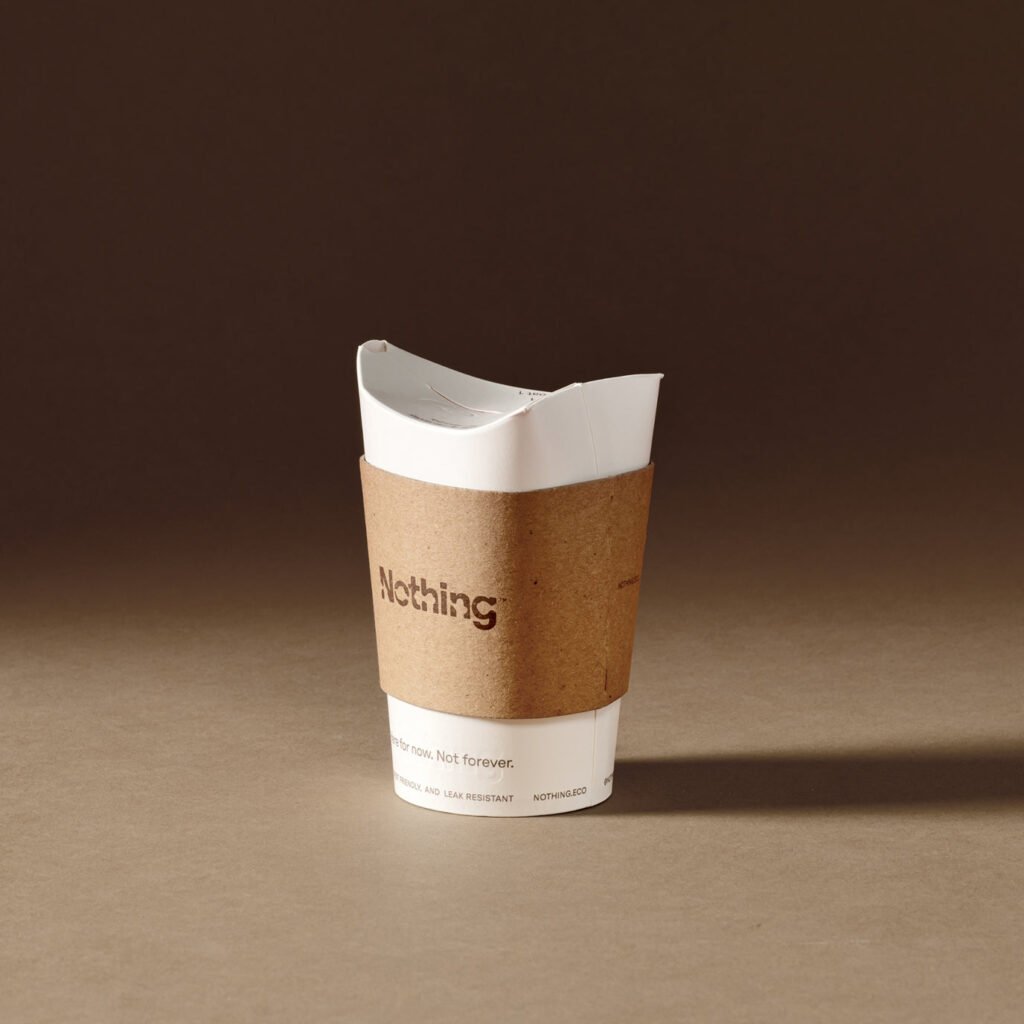
A foldable paper cup uses shaped paper flaps at the top to form an integrated closure and drinking opening. International businesses including Nothing Hot Cup and The Good Cup demonstrate the concept. This guide explains how an entrepreneur in India could evaluate selling these cups to cafés, bakeries and institutions—without pretending that success or profits are guaranteed.
1. What exactly is the product?
Unlike a conventional paper cup with a separate plastic lid, these cups have an extended, engineered upper section. After filling, staff fold the flaps to close it and leave an opening for drinking. Different hot and cold versions can behave differently: Nothing’s Hot Cup offers a sipping spout; its Cold Cup is designed with a hole also suitable for a straw. Do not assume every model is spill-proof, straw-free or suitable for every drink.
See the real products: Nothing Hot Cup · Nothing Cold Cup · The Good Cup authorized distributor example.
2. Who could buy it in India?
- Independent specialty coffee shops wanting distinctive takeaway packaging.
- Premium bakeries and juice bars seeking custom printed cups.
- Event caterers and hotels ordering branded beverage supplies.
- College canteens and cloud kitchens, if pricing and operational durability fit their needs.
- Corporate gifting and branded events purchasing limited-run designs.
Focus your first sales effort on independent cafés and small local chains. Large national chains normally have stringent procurement, testing and scale requirements.
3. Three ways to enter the business
| Model | What you do | Main challenge |
|---|---|---|
| Distributor | Buy authentic compliant cups and sell to cafés | Import cost and minimum orders |
| Contract manufacturer | Arrange authorized production and custom printing | Tooling, minimum orders, quality control, IP rights |
| Own factory | Invest in compatible forming, cutting, coating and printing arrangements | High capex, specialized tooling, testing and consistent orders |
Recommended: Start with distribution/sample testing. Manufacturing rights and machine quotations must be verified before offering a factory startup budget.
4. Real reference pricing versus Indian estimates
Nothing publicly listed 1,000 units of its 8 oz Hot Cup at US$168.99 (about US$0.168 per cup) and 1,000 units of its 8 oz Cold Cup at US$149.99 (about US$0.149 per cup), at the time this guide was researched. These are US website wholesale reference prices, not delivered-to-India prices. Shipping, duties, GST, customs handling, branding and wastage would add costs.
A 2026 distributor brochure for The Good Cup cites a 100,000-piece custom-print MOQ and 30–45-day production lead time, which may vary by vendor and order specifications. Never assume that a trial order automatically qualifies for custom branding.
Illustrative B2B economics — not a supplier quotation
Use the calculator below as a screening example only. Suppose the fully landed cost of an approved cup is ₹10 and you sell it at ₹14 before applicable taxes: gross contribution is ₹4 per cup before local freight, sales commissions, defects, warehousing, samples, overheads and returns. At 10,000 sold units, this is ₹40,000 of gross contribution—not net profit. With landed cost ₹14 and selling price ₹14, contribution becomes zero. Obtain written India-specific quotes before estimating a real margin.
5. Startup budget: what ₹1 lakh can and cannot do
₹1 lakh should not be advertised as the verified cost to build a foldable cup factory. It may be considered a planning envelope for a tiny distribution validation experiment only: samples and freight ₹10k–₹20k; product testing/consultation ₹15k–₹30k; basic branding and sales materials ₹5k–₹10k; customer visits and pilot logistics ₹10k–₹20k; remaining budget reserved for compliant pilot stock and contingency. Actual quotes may make even this plan unworkable. A commercial factory requires a separate equipment, tooling, premises, utilities and working-capital feasibility study.
6. How to source or manufacture safely
- Request genuine physical samples for the exact beverage temperature, volume and intended use.
- Ask whether you are buying finished branded cups, unbranded authorized stock or a licensed design.
- Request technical drawings, materials specification, barrier coating details and the approved use conditions.
- Obtain written food-contact test reports, material conformity documentation and migration testing from suitable NABL-accredited laboratories for Indian requirements.
- Seek written confirmation of design/patent rights and permission for manufacturing or customization in India.
- Compare delivered cost, MOQs, printing charges, lead time and return/replacement terms from multiple vendors.
- Run a paid pilot with local cafés before committing to large orders.
7. Essential testing checklist
- Leakage and seam integrity after folding
- Hot beverage performance at the intended service temperature
- Cold drink condensation, ice handling and prolonged contact
- Folding reliability across repeated batches and barista training
- Tip-over, transport and sipping performance
- Food-contact and coating compliance, print migration and odour/taste checks
- Storage, hygiene, shelf life and carton deformation
- Independent evidence before calling the product plastic-free, recyclable or compostable
India’s Food Safety and Standards (Packaging) Regulations, 2018 and applicable amendments require careful evaluation of direct-food-contact materials. The buyer café’s food-business obligations are not the same as a packaging producer’s business registrations; obtain advice for the exact role and process. FSSAI packaging regulation compendium.
8. Intellectual property and environmental claims
The Good Cup has been described in distributor materials as a patented design. Do not reproduce a photographed folding mechanism or commission lookalike tooling without obtaining professional patent/design clearance for India. A valid distribution arrangement does not automatically confer manufacturing rights.
Paper alone does not prove that a beverage cup is plastic-free or home-compostable. Barrier coatings, adhesives, printing and local waste-management conditions matter. Get material-specific certifications and avoid unsupported sustainability claims.
9. A practical 30-day market-validation plan
- Days 1–7: Contact original manufacturers/distributors; obtain samples, prices, specifications and rights information.
- Days 8–14: Arrange compliance review and beverage-performance tests; interview 15–20 independent cafés about current cup-and-lid spend.
- Days 15–21: Present samples to the most interested cafés; obtain written pilot quantities and acceptable target prices.
- Days 22–30: Calculate landed cost and contribution after all fees; run a small controlled pilot only if documentation, food safety and economics are satisfactory.
Questions to ask every potential café customer
How many takeaway cups do you purchase monthly? What is your total cup-plus-lid cost? What beverage sizes and temperatures are required? Would you accept a new folding workflow? Would you pay extra for custom branding? What minimum delivery frequency and credit terms do you need?
10. Example customer pitch
“We are evaluating a lid-free foldable paper cup for premium takeaway service. It combines the cup and closure in one design and can support custom branding. Would you be open to testing a few samples against your current cup-and-lid combination? We can share approved food-contact documentation and a quote after confirming your required size and quantity.”
11. Is this a good business idea?
Potentially yes, as a specialized B2B packaging supply business. The product is real; premium takeaway presentation is a plausible customer need. But Indian customer willingness to pay, dependable manufacturing access, locally compliant materials, and rights to produce the design remain open commercial questions. Treat a reel as the start of demand research, not proof that anyone will make high profits.
12. What comes next? The detailed blueprint
This free guide explains the product and an actionable first validation path. The upcoming premium Simply Business Hub blueprint will go deeper into verified supplier outreach, machine and tooling options, practical capex and opex models, production workflows, quote templates, compliance paths, margin sensitivity, sample tests and a 90-day execution checklist. Supplier pricing, legal conclusions and commercial projections will be labelled by evidence level.
Want the complete business blueprint?
Follow Simply Business Hub and check our Blueprints section for detailed implementation resources. This guide is educational; verify suppliers, intellectual property, local regulatory obligations and financial assumptions before investing.
Sources and further verification
- Nothing Hot Cup: specifications and published wholesale reference
- Nothing Cold Cup: closure and cold-beverage specifications
- Nothing: material and coating FAQs
- The Good Cup: distributor example
- FSSAI: food packaging regulations compendium
Research note: Published foreign product prices and distributor minimums are indicative of those sources only, as accessed in October 2026. No Indian machine vendor, India manufacturing unit cost, patent clearance or supplier contract has yet been independently verified.