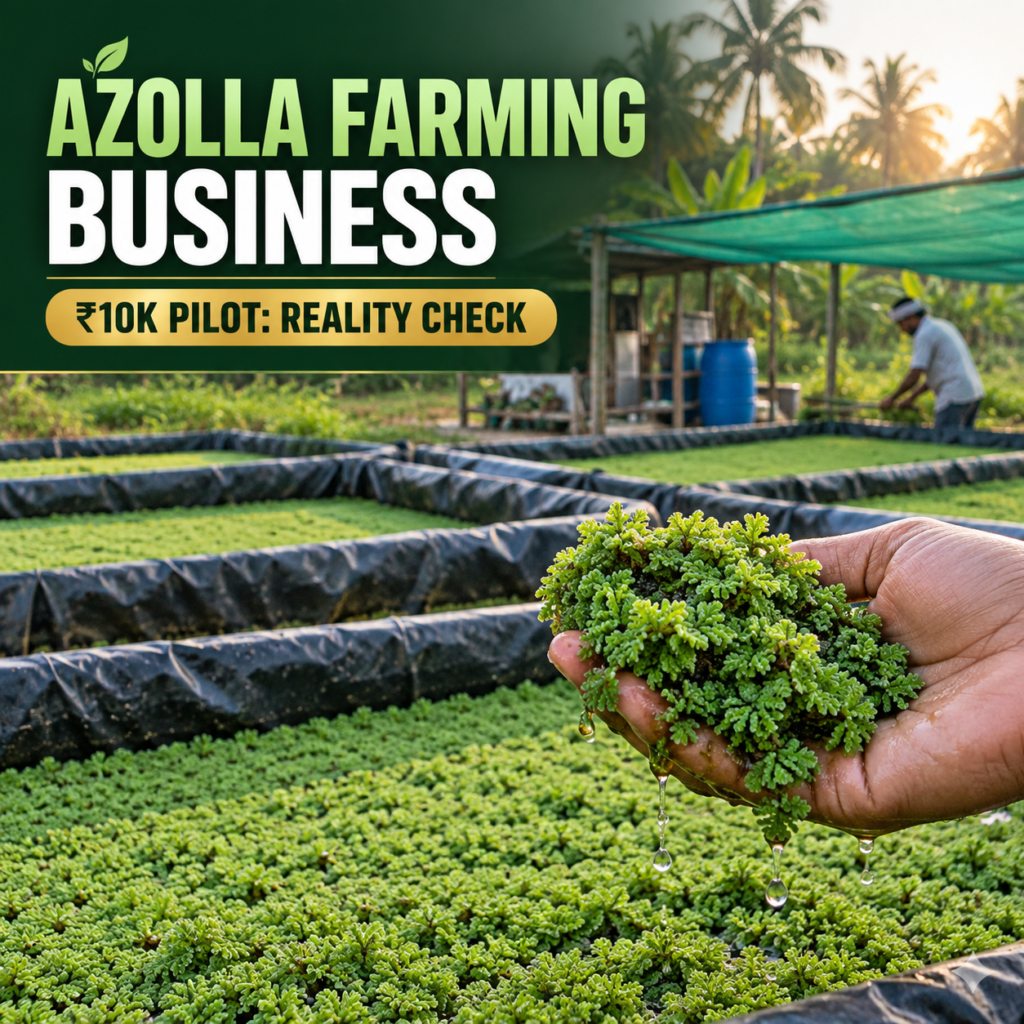
Azolla farming is frequently promoted as a business that can be started with approximately ten thousand rupees and scaled to generate fifty thousand rupees per month.
But is that genuinely possible?
Azolla can be cultivated with relatively little space and a modest pilot investment. However, growing the plant and building a profitable business around it are two different challenges.
Fresh Azolla spoils quickly, contains substantial moisture and normally has a low selling value per kilogram. Therefore, anyone planning to enter this business must understand the market, customer location, product mix and operating risks before investing.
This free Azolla farming starter guide explains the basic investment, cultivation process, customers, revenue opportunities and commercial limitations of starting an Azolla farming business in India.
What Is Azolla?
Azolla is a small floating freshwater fern. It grows on the surface of shallow water and contains protein, minerals and other nutrients.
It is commonly explored for use as:
- A supplementary feed for cattle
- A supplementary feed for poultry and small ruminants
- An input in selected aquaculture systems
- Green manure in paddy cultivation
- A biofertilizer input
- A component in integrated farming systems
Azolla should not be promoted as a complete replacement for balanced animal feed. Livestock feeding decisions must consider the animal’s breed, age, health, existing ration and farm-management conditions.
Farmers should consult a qualified veterinarian or livestock-nutrition professional before making significant changes to an animal’s regular diet.
Why Is There Interest in Azolla Farming?
Commercial feed is one of the major recurring expenses for dairy and poultry farmers. This creates interest in locally available supplementary feed options.
Azolla also attracts aspiring entrepreneurs because it:
- Requires less land than many conventional crops
- Can be cultivated in lined beds or shallow ponds
- May multiply rapidly under suitable conditions
- Can be harvested regularly after establishment
- Has applications in livestock and agriculture
- Can support multiple products and services
However, rapid biological growth does not automatically create market demand. The real business opportunity depends on whether sufficient paying customers are available within a commercially practical distance.
Can You Start Azolla Farming with Ten Thousand Rupees?
A lean pilot may be started within approximately eight thousand to thirteen thousand rupees when land, water and family labour are already available.
This budget may cover:
- Three to six small lined cultivation beds
- Verified starter culture
- Basic soil and nutrient inputs
- Simple shade arrangements
- Water and overflow fittings
- Harvesting sieves and basic tools
- Limited contingency expenses
This estimate does not normally include:
- Land purchase or rent
- Permanent construction
- Commercial water systems
- Laboratory testing
- Paid workers
- Delivery vehicles
- Advertising
- Packaging equipment
- Full working capital
Therefore, ten thousand rupees should be treated as a technical and market-validation budget, not as the complete cost of creating a fully scaled enterprise.
Start small, prove that you can maintain healthy culture and identify paying customers before adding more beds.
Basic Azolla Cultivation Process
One: Select a Suitable Location
Choose a level area with:
- Access to clean, dependable water
- Suitable shade and heat protection
- Proper drainage
- Protection from livestock and pests
- Convenient access for daily monitoring
Avoid contaminated water, sewage, industrial discharge and agricultural runoff with an unknown chemical profile.
Two: Prepare the Cultivation Bed
Azolla may be grown in a shallow lined bed using an appropriate HDPE sheet, silpauline sheet or purpose-built cultivation structure.
The bed must:
- Retain water without leakage
- Maintain an appropriate shallow water level
- Have protected edges
- Include an overflow arrangement
- Remain accessible for cleaning and harvesting
Bed dimensions should be chosen according to the available space, water supply, labour and expected market demand.
Three: Prepare the Growing Medium
A suitable growing medium generally involves clean soil, water and carefully managed nutrients.
Nutrient quantity and replenishment schedules should be locally validated. Excess or unsuitable inputs may encourage algae, produce odour, affect water quality or damage the culture.
Avoid copying random nutrient recipes without considering local water conditions.
Four: Introduce Verified Starter Culture
Purchase starter culture from a credible and traceable source.
The culture should be:
- Free from visible pests
- Free from excessive algae
- Free from foul odour
- Properly identified
- Sourced from clean water
- Supplied with basic cultivation guidance
Unverified culture collected from an unknown pond should not be used for producing livestock feed.
Five: Monitor the Bed Daily
Check the culture every day for:
- Water level
- Water temperature
- Colour and density
- Pest activity
- Algae contamination
- Unusual odour
- Nutrient condition
- Damage caused by rain or heat
Azolla farming is not a passive-income business. Even a small unit requires regular attention.
Six: Begin Controlled Harvesting
Under suitable conditions, a bed may establish within approximately seven to fifteen days. This is an indicative range—not a guaranteed schedule.
Begin harvesting only after the culture forms a healthy and stable mat. Avoid removing too much biomass at once because sufficient culture must remain for regrowth.
Fresh Azolla intended for livestock use should be cleaned appropriately and used or delivered quickly.
Actual production can vary considerably because of weather, water quality, bed management, pests, nutrient balance and operator experience. Maintain a weighed production log for at least thirty days before making financial projections.
Who Can Buy Azolla?
Potential customer segments include:
- Dairy farmers
- Poultry farmers
- Goat and sheep farmers
- Integrated farms
- Paddy farmers
- Aquaculture operators
- Farmer Producer Organisations
- Self-help groups
- Agricultural training centres
- Farm-input retailers
- Organic and natural-farming practitioners
Not every potential user will become a paying customer. Some farmers may produce Azolla themselves after receiving starter culture, while others may not be willing to change their existing feeding practices.
Conduct direct buyer interviews before increasing production.
Useful questions include:
- Are you currently using Azolla?
- Would you prefer fresh supply, starter culture or an installed bed?
- What quantity could you realistically use?
- How frequently would you purchase?
- What quality standards would you expect?
- Are you willing to test a paid pilot?
- Would you require training or maintenance support?
A verbal expression of interest is not the same as a confirmed order. Prioritise paid trials, advance bookings and repeat purchases.
Why Selling Fresh Azolla Alone Is Difficult
Fresh Azolla is approximately ninety to ninety-five percent water. This creates three commercial challenges.
Low Value Per Kilogram
Fresh feed generally carries a relatively low value per kilogram compared with starter culture, cultivation kits or installation services.
Short Usable Life
Fresh Azolla can deteriorate quickly after harvesting. Delayed transportation, heat and poor handling may result in spoilage and customer rejection.
Limited Delivery Radius
Transporting a high-moisture product over a long distance can make delivery uneconomical. Fresh supply normally works best within a concentrated local farming cluster.
Consider a simple reality check.
If fresh Azolla were sold at twenty rupees per kilogram, generating fifty thousand rupees in monthly revenue would require selling approximately two thousand five hundred kilograms every month.
That figure represents revenue—not profit.
Production losses, labour, packaging, delivery, customer acquisition and other expenses must still be deducted. A small ten-thousand-rupee pilot should not be expected to generate that quantity.
A Smarter Azolla Business Model
The commercially stronger opportunity is generally a combination of products and services.
Fresh Azolla Supply
Supply freshly harvested material only to nearby customers through standing or prepaid orders.
Starter Culture Packs
Sell clean, traceable starter culture with appropriate handling and cultivation instructions.
Retail asking prices for starter culture can be higher than prices for fresh feed. However, price depends on quality, quantity, packaging, location, competition and customer trust.
A price advertised online is not proof that customers are purchasing regularly at that price.
DIY Cultivation Kits
A basic kit may combine:
- Liner or ready-to-use bed
- Starter culture
- Essential inputs
- Setup instructions
- Maintenance checklist
- Limited onboarding support
Farm Installation
Install Azolla beds for dairy farms, poultry farms, educational institutions, self-help groups and integrated farms.
Installation creates a higher-value service because the customer is paying for materials, labour, setup and guidance—not merely for the plant.
Maintenance and Bed Rehabilitation
Possible recurring services include:
- Scheduled maintenance visits
- Water and culture inspection
- Pest and algae control
- Bed cleaning
- Culture replacement
- Seasonal preparation
- Record review
- Staff training
A hybrid model can produce higher average order values and more defensible margins than selling fresh Azolla alone.
A Practical Ninety-Day Validation Plan
Days One to Fifteen: Technical Validation
- Establish a small number of beds
- Measure daily water and input requirements
- Observe culture stability
- Record establishment time
- Test heat and rain protection
- Maintain a daily production log
Days Sixteen to Thirty: Buyer Validation
- Identify thirty to fifty potential customers
- Conduct direct interviews
- Explain the product responsibly
- Offer small paid trials
- Attempt to secure at least five paying pilot customers
Days Thirty-One to Sixty: Standardisation
- Record harvesting and cleaning procedures
- Create product and service packages
- Calculate delivery costs
- Establish quality checks
- Confirm packaging and labelling requirements
- Collect structured customer feedback
Days Sixty-One to Ninety: Controlled Expansion
- Expand only against demonstrated demand
- Focus on customers within a manageable radius
- Track revenue, direct cost and owner labour separately
- Compare projected production with actual production
- Retain backup mother culture
- Review whether the business should be continued, modified or stopped
This validation process reduces the risk of investing in beds before establishing a viable customer base.
Major Risks in Azolla Farming
Summer Heat and Culture Collapse
High temperatures may slow growth, cause browning or destroy the culture.
Risk control: Use suitable shade, maintain stable water conditions and retain protected backup culture.
Pest and Algae Contamination
Insects, snails and algae may affect culture quality and productivity.
Risk control: Maintain clean tools, monitor beds daily, quarantine new culture and protect the cultivation area.
Contaminated Water
Poor-quality water may create livestock-safety, environmental and reputational risks.
Risk control: Use a known clean water source and conduct appropriate testing where contamination is possible.
Heavy Rain and Flooding
Rain may overflow beds, dilute nutrients or wash away culture.
Risk control: Install proper overflow systems, raise bed edges and maintain seasonal protection.
Spoilage During Delivery
Fresh Azolla may deteriorate while waiting or travelling.
Risk control: Harvest against confirmed orders, drain appropriately, use short delivery routes and establish clear delivery timings.
Overestimating Demand
Online interest does not guarantee local purchases.
Risk control: Complete buyer interviews and paid trials before increasing cultivation capacity.
Who Is This Business Suitable For?
Azolla farming may suit someone who:
- Already has access to land and clean water
- Lives near a dairy, poultry or agricultural cluster
- Can supervise the unit daily
- Is comfortable with hands-on farm work
- Can communicate directly with farmers
- Is willing to start with a small pilot
- Can maintain production and customer records
- Understands that market development is harder than cultivation
It may not suit someone who:
- Wants passive income
- Cannot visit the site regularly
- Has no dependable clean-water source
- Plans to transport fresh Azolla over long distances
- Expects guaranteed monthly income
- Is unwilling to conduct customer validation
- Intends to make unverified livestock-performance claims
Can Azolla Farming Generate Fifty Thousand Rupees Per Month?
It may be possible to target fifty thousand rupees in monthly revenue through a validated hybrid model involving kits, starter culture, installations, maintenance and limited fresh supply.
It should not be presented as an expected monthly profit from a ten-thousand-rupee cultivation unit.
The outcome depends on:
- Number of paying customers
- Product and service mix
- Local pricing
- Customer-acquisition cost
- Cultivation stability
- Delivery distance
- Labour requirements
- Seasonal losses
- Repeat-purchase rate
- Quality and reputation
No responsible business plan can guarantee the same result for every entrepreneur.
Ready to Build Your Complete Azolla Business Plan?
This free guide gives you the fundamentals. But before investing, you still need to answer several location-specific questions:
- What should your complete pilot budget include?
- How many beds can your projected demand support?
- Which revenue stream offers the best contribution margin?
- What happens when production or sales fall below expectations?
- How much fresh Azolla must be sold to reach a revenue target?
- Is your proposed site commercially suitable?
- What operational and compliance risks must be addressed?
- When should you scale, pause or reject the opportunity?
The Azolla Farming Business Blueprint + Financial Model was created to help answer these questions.
The Complete Bundle Includes
- A twenty-nine-page evidence-based business blueprint
- Editable pilot setup budget
- Product-level unit economics
- Twelve-month hybrid-business forecast
- Fresh-feed scale reality calculator
- Profit sensitivity analysis
- Site feasibility scorecard
- Risk register and mitigation controls
- Buyer-validation strategy
- Ninety-day execution roadmap
- Compliance and responsible-marketing guidance
- Source references and limitations
- Formula-integrity checks
Instead of relying on viral income claims, enter your own local costs, prices, production and sales assumptions into the Excel model and examine the possible outcome before committing significant capital.
Launch Bundle: ₹99 (Limited time offer )
[GET THE COMPLETE AZOLLA BUSINESS BLUEPRINT + EXCEL MODEL]
Replace this button with the WooCommerce product-page link.
Frequently Asked Questions
Is Azolla a complete animal feed?
No. Azolla should be treated as a supplementary input within an appropriately balanced ration. Consult a qualified veterinarian or livestock-nutrition professional before changing animal feeding practices.
How quickly does Azolla grow?
Azolla may establish and multiply rapidly under suitable conditions. An indicative establishment period is approximately seven to fifteen days, but performance varies with weather, water, nutrients, pests and maintenance.
Can I start Azolla farming at home?
A small technical pilot may be possible when you have a suitable outdoor location, clean water, shade, drainage and the ability to monitor the bed every day.
Is ten thousand rupees sufficient?
It may be sufficient for a lean pilot if land, water and family labour are already available. It is not necessarily sufficient for a complete commercial enterprise.
Can starter culture be sold for three hundred to four hundred rupees per kilogram?
Some sellers may advertise starter culture within or above this range. Actual realised prices depend on location, culture quality, quantity, packaging, competition and customer trust. Fresh-feed prices should not be confused with starter-culture retail prices.
What is the best Azolla business model?
For many small entrepreneurs, a hybrid model combining starter culture, DIY kits, installation, maintenance and hyperlocal fresh supply is commercially stronger than fresh-feed-only selling.
Is monthly income guaranteed?
No. Income, production, customer demand and profit cannot be guaranteed. The purpose of the blueprint and Excel model is to support responsible validation and planning.
Final Verdict
Azolla farming can become a modest agricultural supply and service business when the entrepreneur has suitable resources, daily operating discipline and access to genuine local demand.
The plant may be easy to multiply under good conditions. Creating a reliable business around it requires much more: customer validation, quality control, cost management, responsible claims and an appropriate mix of products and services.
Start with a small pilot. Measure actual production. Secure paying customers. Scale only after the evidence supports expansion.
[VIEW THE COMPLETE AZOLLA BUSINESS BLUEPRINT]
Disclaimer
This article is intended solely for educational and informational purposes. It does not guarantee income, profit, cultivation output, market demand or livestock-performance outcomes.
Costs, prices, regulations and operating conditions vary by location and over time. Obtain current local quotations and consult qualified veterinary, legal, tax, environmental and compliance professionals where appropriate before investing.
Reference Resources
- Tamil Nadu Agricultural University — Azolla and integrated-farming guidance
- NABARD and TNAU — Azolla fodder model project
- Feedipedia — Azolla feed-resource and aquaculture profiles
Published by Simply Business Hub
Evidence-based business ideas, practical blueprints and planning tools for Indian entrepreneurs.