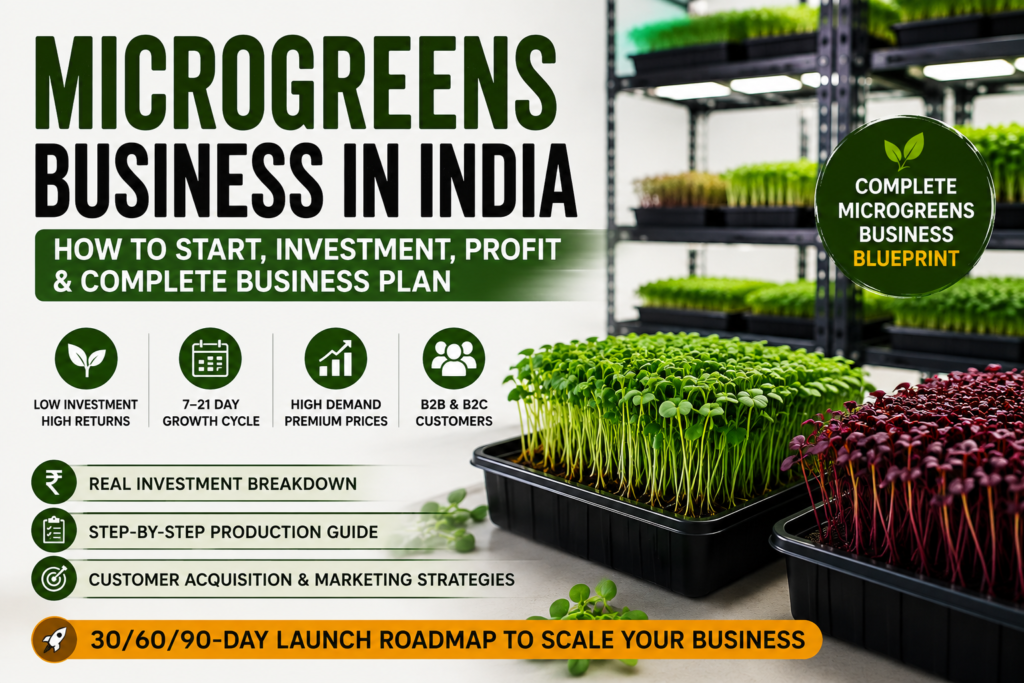
Microgreens are becoming an interesting business opportunity for entrepreneurs looking for a food business that can be started with relatively limited space.
But is a microgreens business actually profitable in India?
The answer is: it can be — but not simply because microgreens are easy to grow.
The real business comes from being able to consistently produce good-quality microgreens, find customers, price correctly, control wastage and generate repeat orders.
In this guide, we will explain how the microgreens business works, what you need to start, who your customers can be, how pricing works and what you should validate before investing heavily.
WHAT ARE MICROGREENS?
Microgreens are young edible plants harvested at an early stage of growth.
Popular varieties include:
- Radish
- Sunflower
- Pea shoots
- Mustard
- Broccoli
- Mung
- Fenugreek
- Amaranth
- Coriander
Different varieties behave differently.
They can have different:
- Growing periods
- Seed costs
- Yields
- Flavours
- Appearance
- Customer demand
- Selling prices
This is why there is no single formula such as “grow 100 trays and make ₹1 lakh per month.”
A realistic business plan needs to calculate the economics based on the crop, tray size, production method, selling price and actual customer demand.
WHY ARE MICROGREENS INTERESTING AS A BUSINESS?
One of the biggest advantages of microgreens is that they don’t necessarily require a large agricultural landholding.
A properly designed setup can make use of vertical space through racks and trays.
The basic business cycle is:
SEED → GERMINATION → GROWING → HARVEST → PACKAGING → DELIVERY → REPEAT ORDER
The relatively short production cycle also gives a new entrepreneur an opportunity to test the market without immediately building a large operation.
That leads to an important distinction:
STARTING A BUSINESS
versus
TESTING A BUSINESS
Instead of investing heavily from day one, a smarter approach is to start with a small validation setup, test a few varieties, approach potential customers and then decide whether scaling makes sense.
HOW MUCH INVESTMENT IS REQUIRED TO START A MICROGREENS BUSINESS?
There is no single investment figure that applies to every microgreens business.
Your actual investment depends on:
- Available space
- Number of trays
- Racks
- Lighting
- Seeds
- Growing medium
- Packaging
- Hygiene equipment
- Ventilation
- Storage
- Refrigeration
- Delivery requirements
A small setup designed for learning and market validation can cost much less than a structured commercial operation.
Instead of asking:
“How much does a microgreens business cost?”
A better question is:
“How much should I spend before proving that customers will actually buy?”
This approach can help avoid one of the most common mistakes in small businesses:
BUYING EQUIPMENT FIRST AND SEARCHING FOR CUSTOMERS LATER.
A better progression is:
STAGE 1 — VALIDATE
Start small → Produce limited quantities → Test customers.
STAGE 2 — STABILISE
Improve production → Standardise quality → Build repeat orders.
STAGE 3 — SCALE
Increase production only when demand justifies it.
WHAT EQUIPMENT DO YOU NEED?
A basic microgreens production setup can include:
- Growing trays
- Racks
- Suitable lighting
- Seeds
- Growing medium
- Watering equipment
- Fans and ventilation
- Timers
- Hygrometer
- Weighing scale
- Harvesting tools
- Packaging materials
- Cleaning and sanitation supplies
The exact equipment requirement depends on the size of your operation.
Someone producing a few trays to validate the market does not need the same infrastructure as a business supplying multiple restaurants every week.
This is why equipment purchases should follow sales validation.
Not the other way around.
WHICH MICROGREENS SHOULD YOU GROW?
One of the biggest beginner mistakes is trying to grow too many varieties from the beginning.
You may see dozens of attractive microgreens online, but that doesn’t mean your local customers will buy all of them.
Different crops have different:
- Germination behaviour
- Harvest windows
- Seed costs
- Yield potential
- Flavour profiles
- Customer preferences
A better approach is to start with a small mix of varieties and measure what actually sells.
For example, you could test:
- A fast-growing variety
- A popular flavour variety
- A visually attractive variety
- A premium variety
After a few production cycles, your own sales data becomes more valuable than assumptions.
Your customers should ultimately determine which varieties you scale.
WHO WILL BUY MICROGREENS?
This is one of the most important parts of the business.
Potential customer segments include:
RESTAURANTS
Restaurants may use microgreens for plating, salads, sandwiches and premium dishes.
CAFÉS
Especially cafés that focus on healthy, premium or visually appealing food.
SALAD & HEALTHY FOOD BUSINESSES
Microgreens can complement salads, bowls and health-focused meals.
GYMS & FITNESS BUSINESSES
These can provide access to health-conscious customers.
PREMIUM GROCERY STORES
Retail stores can provide access to customers looking for fresh and premium food products.
DIRECT CONSUMERS
You can also explore direct sales through:
- Apartment communities
- Local communities
- Referrals
- Subscription models
But there is an important difference between B2B and B2C.
B2B customers may purchase larger quantities at a lower price per gram.
B2C customers may purchase smaller quantities at a higher retail price.
Therefore:
B2B PRICING ≠ B2C PRICING
Your business model needs to account for this difference.
HOW SHOULD YOU PRICE MICROGREENS?
Avoid copying one price from another Instagram page and assuming it will work for your business.
Microgreens pricing can vary depending on:
- Crop
- City
- Customer type
- Order quantity
- Packaging
- Delivery distance
- Freshness
- Brand positioning
- Repeat-order volume
There are three useful pricing approaches.
- COST-PLUS PRICING
Calculate your true cost and add your required margin.
- MARKET-BASED PRICING
Research what comparable sellers are charging in your local market.
- VALUE-BASED PRICING
Price according to the value and positioning you create for the customer.
A serious business should understand all three approaches.
THE MOST IMPORTANT CALCULATION: TRUE COST
This is where many small businesses make mistakes.
Your cost is not simply:
Seeds + Growing Medium
Your actual business cost can include:
Seeds
+
Growing Medium
+
Water
+
Electricity
+
Packaging
+
Labour
+
Cleaning & Sanitation
+
Wastage
+
Equipment Depreciation
+
Delivery Allocation
=
TRUE COST
Only after calculating the true cost should you decide whether your selling price leaves enough contribution.
DON’T CONFUSE PRODUCTION WITH SALES
This is perhaps the most important lesson in the entire business.
Imagine your setup can theoretically produce 10 kg of microgreens.
That does NOT automatically mean you will sell 10 kg.
You may produce 10 kg but sell only 7 kg.
The remaining quantity may face:
- Wastage
- Quality deterioration
- Unsold inventory
- Discounted sales
This is why one of the most important metrics is:
SELL-THROUGH RATE
Sell-through rate = Quantity Sold ÷ Quantity Produced × 100
For example:
10 kg produced
7 kg sold
Sell-through rate = 70%
That number is much more useful for business planning than simply looking at your theoretical production capacity.
IS MICROGREENS FARMING PROFITABLE IN INDIA?
Microgreens can be profitable, but profitability depends on execution.
The basic calculation is:
SELLABLE QUANTITY
×
ACTUAL SELLING PRICE
−
VARIABLE COSTS
−
LABOUR
−
PACKAGING
−
DELIVERY
−
FIXED COSTS
=
OPERATING PROFIT
This is why claims such as:
“Grow microgreens and make ₹1 lakh every month”
should be treated carefully.
The better question is:
“At what production volume, selling price, sell-through rate and cost structure?”
A realistic business plan should always show the assumptions behind the number.
THE BIGGEST RISK ISN’T GROWING
The biggest risk is often demand validation.
Imagine spending ₹1 lakh on equipment, starting production and then discovering that you don’t have enough customers.
Now you have production capacity without sufficient demand.
A smarter approach is:
STEP 1
Identify potential customers.
STEP 2
Speak to them.
STEP 3
Understand their requirements.
STEP 4
Offer samples.
STEP 5
Get trial orders.
STEP 6
Measure repeat orders.
STEP 7
Increase production only when demand justifies it.
This is a validation-first approach.
HOW TO GET YOUR FIRST 10 CUSTOMERS
You don’t need thousands of Instagram followers to test this business.
Start locally.
Build a list of:
- Restaurants
- Cafés
- Salad businesses
- Gyms
- Nutrition-focused businesses
- Premium grocery stores
Then contact them directly.
A simple introduction could be:
“Hi, we are a local microgreens grower supplying fresh varieties for restaurants and healthy-food businesses. We are currently offering samples to a few local businesses. Would you be open to trying a small sample pack?”
The objective isn’t to immediately sell a large order.
The objective is:
CONVERSATION → SAMPLE → TRIAL → FEEDBACK → REPEAT ORDER
That is your initial sales funnel.
WHAT SHOULD YOU VALIDATE BEFORE SCALING?
Before buying more racks or expanding production, answer these questions.
DEMAND
Can I find customers who are willing to pay?
PRICING
Will customers accept my actual selling price?
PRODUCTION
Can I consistently produce the quality they expect?
WASTAGE
How much of what I produce actually gets sold?
DELIVERY
Does delivery still leave enough contribution?
REPEAT ORDERS
Do customers reorder?
UNIT ECONOMICS
Does the business remain viable after including all relevant costs?
If you cannot answer these questions yet, you may not need a bigger farm.
You need more validation.
A PRACTICAL 30/60/90-DAY APPROACH
DAYS 1–30: VALIDATE
- Research your local market
- Identify potential customers
- Test 3–5 varieties
- Calculate your actual production cost
- Produce small batches
- Collect customer feedback
- Try to get your first paying customers
DAYS 31–60: STABILISE
- Standardise production
- Track yield
- Track wastage
- Track cost
- Track selling price
- Track customer acquisition
- Track repeat orders
- Improve packaging
- Improve delivery routes
- Identify your best-selling varieties
DAYS 61–90: SCALE CAREFULLY
Increase production only when:
- Customers are reordering
- Production is consistent
- Wastage is under control
- Unit economics make sense
- Delivery economics work
- Demand is greater than your current capacity
DON’T SCALE BECAUSE YOUR RACKS HAVE EMPTY SPACE.
SCALE BECAUSE YOUR CUSTOMERS ARE ASKING FOR MORE.
WHAT MOST MICROGREENS BUSINESS GUIDES DON’T TELL YOU
The business isn’t simply:
GROW → SELL → PROFIT
It is:
RESEARCH
↓
VALIDATE DEMAND
↓
CHOOSE CROPS
↓
PRODUCE CONSISTENTLY
↓
CALCULATE TRUE COST
↓
PRICE CORRECTLY
↓
ACQUIRE CUSTOMERS
↓
CONVERT TRIAL ORDERS
↓
BUILD REPEAT ORDERS
↓
CONTROL WASTAGE
↓
SCALE
That is the real business system.
And if you’re serious about starting, you need more than a list of equipment and a few videos.
You need a practical roadmap.
GET THE COMPLETE MICROGREENS BUSINESS BLUEPRINT
We’ve created a research-backed Microgreens Business Blueprint specifically for Indian entrepreneurs who want to understand the business before investing heavily.
Inside the complete blueprint, you’ll get:
✓ STARTUP INVESTMENT BREAKDOWN
Understand what you actually need to spend at different stages and where you should avoid unnecessary spending.
✓ PRODUCTION SOP
A structured Seed → Harvest → Packaging workflow designed to help you build a repeatable production process.
✓ CROP SELECTION FRAMEWORK
Understand what to test, how to compare varieties and how to use your own sales data to decide what to scale.
✓ FOOD SAFETY & HYGIENE SYSTEM
Understand the practical hygiene, sanitation and food-safety considerations involved in operating a professional setup.
✓ UNIT ECONOMICS
Calculate your actual cost per tray, cost per 100g, selling price and contribution.
✓ FINANCIAL MODELS
Work through conservative, base-case and expansion scenarios using transparent assumptions rather than exaggerated income claims.
✓ BREAK-EVEN ANALYSIS
Understand how much you need to sell before your business covers its operating costs.
✓ B2B CUSTOMER ACQUISITION SYSTEM
Learn how to approach restaurants, cafés, gyms, healthy-food businesses and other potential customers.
✓ READY-TO-USE SALES SCRIPTS
Get practical WhatsApp, DM, calling, follow-up and objection-handling scripts.
✓ B2C MARKETING STRATEGY
Explore practical ways to build local demand through Instagram, WhatsApp, communities, referrals and subscriptions.
✓ 30/60/90-DAY LAUNCH PLAN
Follow a structured path from initial validation to controlled scaling.
✓ RISK & RED-TEAM ANALYSIS
Understand what can go wrong before you invest heavily.
THE GOAL ISN’T TO CONVINCE YOU TO START
That’s important.
The blueprint isn’t designed to tell everyone:
“Yes, start a microgreens business.”
Instead, it helps you answer:
Should I start?
How much should I invest?
What should I test first?
Who should I sell to?
What should I charge?
Can the numbers work in my market?
When should I scale?
That’s the difference between a generic business ebook and a practical business blueprint.
READY TO GO DEEPER?
If you’re seriously exploring the microgreens business in India, don’t make your first investment based on random profit screenshots or exaggerated income claims.
Understand the numbers.
Validate the demand.
Build the system.
Then scale.
👉 GET THE COMPLETE MICROGREENS BUSINESS BLUEPRINT
Research-backed. Practical. India-focused. Built for execution.
₹499
CLICK HERE TO GET THE COMPLETE BLUEPRINT →
Related Business Guides
FINAL THOUGHT
Microgreens can be an interesting opportunity for entrepreneurs who are willing to treat it like a real business rather than a quick-income idea.
The strongest approach is simple:
START SMALL.
VALIDATE DEMAND.
TRACK YOUR NUMBERS.
BUILD REPEAT CUSTOMERS.
SCALE ONLY WHEN THE ECONOMICS WORK.
If you want the complete step-by-step framework, including the production SOP, investment model, unit economics, customer acquisition system, sales scripts, financial projections, risk analysis and 30/60/90-day roadmap, get the complete Microgreens Business Blueprint.