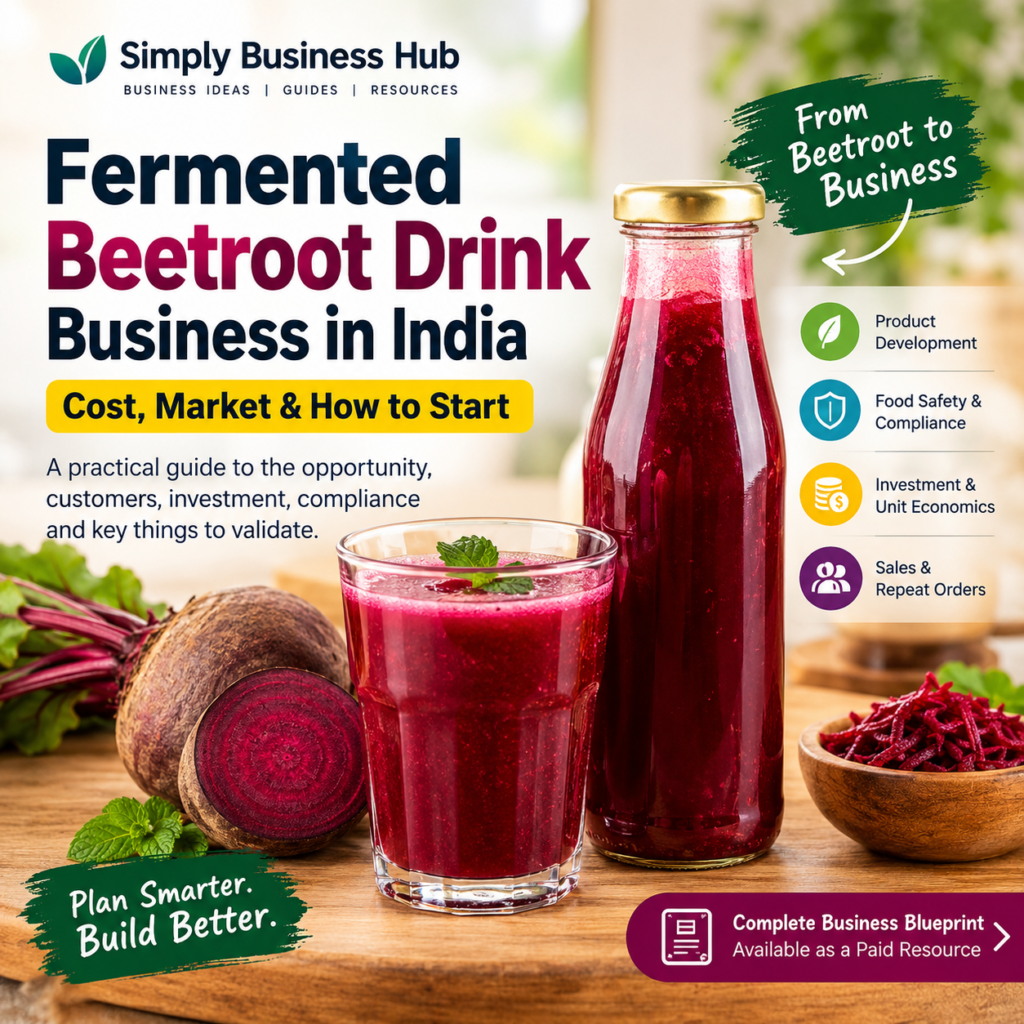
A fermented beetroot drink may look like a simple homemade beverage, but turning it into a sellable food business in India is a very different challenge.
The interesting part is not simply fermenting beetroot.
The real business questions are:
- Who will actually buy it?
- What will they pay?
- How will you make every batch consistently?
- How will you control fermentation, acidity, alcohol and shelf life?
- What packaging can safely handle the finished product?
- What will one sale actually contribute after delivery and selling costs?
- Can customers be persuaded to buy again, rather than simply try it once?
This free guide explains the business opportunity at a practical level and shows what an entrepreneur should investigate before investing heavily.
If you want the complete version—including product-development planning, validation targets, production workflow, compliance checklist, investment scenarios, bottle-level costing, pricing models, break-even calculations, sales scripts, operating records and a 90-day launch framework—you can go deeper with the Simply Business Hub Fermented Beetroot Drink Business Blueprint.
Important: This article is an educational business-planning guide. It is not a commercial recipe, food-safety approval, legal opinion or guarantee of profit. A fermented beverage requires product-specific technical validation before manufacture or sale.
What Is a Fermented Beetroot Drink Business?
The basic concept is a beetroot-based fermented beverage developed around a distinctive taste, convenient packaging and a repeatable production process.
The opportunity is interesting because beetroot provides a naturally distinctive colour and flavour profile, while fermentation can create a product identity that is different from conventional juices and soft drinks.
But there is an important distinction:
Fermented does not automatically mean probiotic, healthy, safe or alcohol-free.
The paid blueprint specifically treats those assumptions as things that need evidence rather than marketing claims. Fermentation involves microbial activity, so the actual process, formulation, packaging and storage conditions matter.
That is why this business should be approached as a food-product development project, not simply as a recipe copied from Instagram or YouTube.
Why Could Fermented Beetroot Drinks Become a Business Opportunity?
The product has several characteristics that can make it commercially interesting:
1. Distinctive appearance
Beetroot naturally gives the beverage a strong visual identity.
That can be useful for:
- Instagram Reels
- Product photography
- Café menus
- Sampling events
- Premium beverage positioning
2. A different taste proposition
Instead of competing only with ordinary fruit juices, the product can be positioned around a tangy, savoury or spiced drinking experience.
However, the taste has to be validated.
A product can look attractive on social media and still fail to generate repeat purchases.
3. Local production potential
A small entrepreneur could investigate a hyperlocal chilled beverage model, supplying nearby households, cafés and selected food outlets instead of immediately attempting national distribution.
The blueprint’s initial working concept uses one flavour, a provisional 250 ml pack, a compact delivery area and selected café trials. These are planning assumptions—not universal industry standards.
4. Premium-product possibility
The product does not necessarily need to compete with low-priced mass beverages.
A premium proposition could be built around:
- distinctive flavour
- attractive packaging
- transparent ingredients
- controlled production
- consistent quality
- convenient local delivery
But premium pricing has to be supported by actual willingness to pay.
Who Could Buy a Fermented Beetroot Drink?
One of the biggest mistakes in a new food business is trying to sell to everyone.
Instead, start with one customer group.
The blueprint identifies several possible segments worth testing:
Local cafés and meal outlets
The drink could be tested as an alternative beverage accompanying meals.
Apartment households
A chilled multipack could potentially work for grouped local delivery.
Specialty beverage buyers
Customers already interested in distinctive or premium beverages could be approached through tastings and selected stores.
The important question is not:
“Will people like beetroot?”
The better question is:
“Which specific customer will pay for this product repeatedly, at the price we need?”
That distinction is critical.
Competitor listings and social-media interest can provide clues, but they do not prove that your local market will buy your product.
How Much Investment Is Needed?
There is no single correct investment figure because the business model can vary significantly.
A small fermented beverage operation may require expenditure on:
- product development
- technical validation
- equipment
- premises or shared production space
- packaging
- ingredients
- testing
- compliance
- refrigeration
- delivery
- working capital
- marketing
The blueprint presents three illustrative planning envelopes: Model Illustrative budget Lean shared pilot ₹2 lakh Base local unit ₹3.6 lakh Higher-capacity unit ₹7 lakh
These are model assumptions, not supplier quotations. They exclude major items such as land purchase, a delivery vehicle, major building work, automated production equipment and specialist stabilisation equipment.
This is an important distinction.
You should not interpret ₹2 lakh, ₹3.6 lakh or ₹7 lakh as guaranteed startup costs.
Your actual requirement should be calculated from current quotations and your selected production route.
The Cost of One 250 ml Bottle
The paid blueprint also demonstrates why calculating only ingredient cost can produce a misleading business plan.
Its illustrative 50-litre model assumes 45 litres of saleable finished drink, producing 180 bottles of 250 ml.
Under that model:
- Ingredients and water: ₹1.50/bottle
- Packaging allocation: ₹12.00
- Direct processing labour: ₹2.00
- Cleaning, water and energy: ₹0.70
- Routine quality/testing allocation: ₹1.00
Illustrative production cost: ₹17.20 per bottle.
After adding delivery and selling-related variable costs, the model reaches approximately:
- ₹23.20 per bottle for direct grouped orders
- ₹22.20 per bottle for café/retail supply
These are planning assumptions, not actual market quotations.
And this is exactly why a beverage business should not be planned around:
“Beetroot is cheap, so the profit must be high.”
The bottle, labour, testing, refrigeration, delivery, wastage and selling costs can completely change the economics.
What Price Could You Charge?
Pricing should be determined by the channel and the actual economics—not simply by adding a margin to ingredient cost.
For example, the blueprint models a ₹42 net receipt scenario for direct sales.
Under the illustrative model: Channel Net receipt Variable cost Contribution Direct grouped orders ₹42.00 ₹23.20 ₹18.80 Café / retailer supply ₹31.50 ₹22.20 ₹9.30 60% direct + 40% trade ₹37.80 ₹22.80 ₹15.00
Again, these are model scenarios rather than recommended market prices.
The blueprint also demonstrates that a ₹30 retail bottle does not work with the illustrated cost structure unless the business changes something fundamental—such as the validated cost, pack format, channel or serving size.
That is an important business lesson:
Do not reduce food-safety or testing standards simply to make a selling price work.
Can This Business Make ₹50,000 Per Month?
There is no responsible way to promise a fixed monthly income from a new fermented beverage.
Instead, calculate the economics from actual sales.
The blueprint’s base illustrative scenario assumes:
- 4,500 bottles sold per month
- ₹37.80 net receipt per bottle
- ₹22.80 variable cost per bottle
- ₹45,000 fixed operating cost
That produces an illustrative operating result of ₹22,500 per month before depreciation, interest, income tax and startup-cost recovery.
The same model shows:
- 1,500 bottles/month → operating loss of ₹31,500
- 4,500 bottles/month → operating result of ₹22,500
- 7,500 bottles/month → operating result of ₹62,500
These figures are scenario calculations, not forecasts.
The lesson is more useful than the headline number:
The same product can move from loss to contribution depending on volume, channel, pricing and cost structure.
The Most Important Question: Will Customers Reorder?
A food business is not validated because:
- a Reel received many views
- people commented “interested”
- friends liked the sample
- one shop purchased a case
- customers said the drink was “good”
Those are useful signals.
But paid repeat purchases are much stronger evidence.
The blueprint proposes a staged validation approach:
Step 1 — Customer interviews
Speak with approximately 20 target customers and 5 outlet buyers.
Understand:
- what drinks they currently purchase
- when they drink them
- what they spend
- what they dislike
- what would make them switch
Step 2 — Product testing
Once the product is technically cleared for sampling, test it with target customers outside your immediate circle.
Step 3 — Paid trial
The blueprint uses 50 distinct paying customers as a proposed management target.
Step 4 — Track repeat purchases
Observe eligible customers over a 30-day period.
The blueprint’s illustrative decision rule is to continue testing when at least 25% of eligible first-time buyers place a paid repeat order within 30 days and contribution is positive. This is explicitly a management target, not an industry benchmark.
That is the kind of validation that can turn a food idea into a real business case.
What About the Recipe?
This is where the business blueprint intentionally differs from many social-media business videos.
There is no universal commercial recipe provided.
Why?
Because a home recipe is not automatically a commercial manufacturing specification.
A commercial product needs its actual:
- formulation
- fermentation method
- time-temperature controls
- acidity controls
- packaging
- storage conditions
- shelf life
- release criteria
to be established and validated for the specific product.
The blueprint recommends commissioning a qualified food technologist or appropriate development specialist rather than simply copying an online recipe.
So if you see someone saying:
“Ferment beetroot for X days, bottle it and sell it.”
Treat that as a starting idea for investigation—not as a validated commercial process.
Food Safety Is a Business Issue, Not Just a Technical Issue
Fermented beverages can involve ongoing microbial activity.
That means the entrepreneur needs to consider:
- microbiological safety
- acidity and process behaviour
- alcohol development
- gas formation
- pressure
- packaging integrity
- storage conditions
- shelf life
- distribution temperature
A pH measurement alone does not prove that the finished product is safe.
The blueprint recommends that laboratory and technical work consider the actual formulation, packaging, intended shelf life, separate batches, storage conditions and appropriate acceptance criteria.
This is also why claims such as “zero alcohol,” “probiotic,” “detox,” “improves digestion” or “healthier” should not simply be added to the label because another brand uses them.
Claims need appropriate evidence and regulatory review.
What About FSSAI and Other Compliance?
Before selling a packaged fermented beverage in India, the entrepreneur needs to determine the applicable food category, licensing route, labelling requirements and other business obligations.
The blueprint specifically identifies areas such as:
- FSSAI classification and FoSCoS
- licensing/registration
- food safety management
- Legal Metrology and packaging declarations
- GST
- local business requirements
- packaging responsibilities
- contracts and brand protection
The exact requirements depend on the product, premises and business model, so this article should not be treated as a legal clearance. The blueprint also states that its regulatory snapshot must be reconfirmed before launch.
How Could You Sell It?
A sensible initial strategy is to stay local.
Possible channels include:
Direct local orders
Use Instagram, WhatsApp and local community networks to generate paid orders.
Apartment/community delivery
Group multiple orders into scheduled delivery slots to control delivery economics.
Cafés
Offer a small paid trial rather than asking for permanent shelf space immediately.
Selected stores
Track actual sell-through instead of treating delivered inventory as proof of demand.
Local creator campaigns
Work with relevant local creators, but measure actual paid orders rather than follower count or views.
The blueprint recommends measuring activities such as sample-to-paid conversion, customer acquisition cost, paid reorders and units sold per outlet-day.
A Simple 90-Day Approach
A practical development path could look like this:
Days 1–15: Validate the idea
- Interview potential customers
- Study local competing beverages
- Check possible price points
- Speak with technical specialists
- Identify potential production routes
Days 16–45: Develop
- Formulation trials
- Packaging investigation
- Supplier quotations
- Technical validation
- Compliance planning
- Shelf-life work
Days 46–60: Verify
- Complete required validation
- Review the label
- Train the operator
- Establish traceability
- Confirm release criteria
Days 61–90: Run a paid pilot
- Start with small local orders
- Test selected outlets
- Track returns
- Track repeat purchases
- Measure contribution
- Collect payments on time
The important point is that 90 days is an illustrative planning framework, not a guaranteed launch timeline. Safety evidence and regulatory requirements determine when the product is actually ready for sale.
Is Fermented Beetroot Drink a Good Business Idea?
That question is better answered with evidence than enthusiasm.
A fermented beetroot drink could become an interesting local beverage business if the entrepreneur can establish:
- a product people genuinely enjoy
- a clearly defined customer
- a repeatable and validated process
- compliant packaging and labelling
- workable shelf life
- controlled cold-chain or other validated storage
- positive contribution per bottle
- reliable local delivery
- repeat purchases
The biggest mistake would be to invest heavily before proving those things.
Start with evidence.
Develop the product properly.
Run a paid pilot.
Measure repeat buying.
Then decide whether scaling makes sense.
Want the Complete Business Blueprint?
This free guide gives you the business idea, major cost drivers, validation logic and commercial reality.
But there is much more work involved if you actually want to evaluate and launch the business.
The complete Simply Business Hub Fermented Beetroot Drink Business Blueprint goes deeper into:
- Product development
- Customer and market validation
- Production-route selection
- Technical development brief
- Batch-production workflow
- Food-safety and shelf-life testing framework
- Equipment and supplier checklist
- FSSAI and compliance checklist
- Packaging and label requirements
- Startup investment scenarios
- Detailed 250 ml bottle costing
- Channel-wise pricing
- Break-even analysis
- Cash-flow considerations
- Café and retailer sales approach
- Trial-order structure
- Local marketing strategy
- WhatsApp reorder strategy
- Batch and stock records
- Recall and risk-control framework
- 90-day launch roadmap
- Practical founder checklist
The blueprint is designed to help you answer a much more important question than “Can I make fermented beetroot drink?”
It helps you investigate:
“Can I turn this product into a controlled, testable and commercially viable local beverage business?”
Get the Complete Fermented Beetroot Drink Business Blueprint
[GET THE COMPLETE BLUEPRINT →]
Paid blueprint. Educational planning resource. No guaranteed revenue, profit, approvals, product safety or health outcomes. Product-specific technical and regulatory validation is required before commercial sale.
Frequently Asked Questions
Is fermented beetroot drink a good small business idea in India?
It can be investigated as a small local beverage opportunity, but success depends on customer demand, validated production, pricing, distribution, compliance and repeat purchases. There is no guaranteed level of demand or profit.
How much does it cost to start a fermented beetroot drink business?
The cost depends on the production route and scale. The Simply Business Hub planning model illustrates budgets from ₹2 lakh for a lean shared pilot to ₹7 lakh for a higher-capacity local setup. These are planning assumptions rather than quotations.
Can I make fermented beetroot drink at home and sell it?
Do not assume that a home recipe or home kitchen is automatically suitable for commercial packaged-beverage production. The actual production premises, permissions, process, food-safety controls, testing and licensing requirements need to be evaluated before sale.
Is fermented beetroot drink automatically probiotic?
No. Fermentation by itself does not establish that a product qualifies as a probiotic food. Any such claim requires appropriate evidence.
Is fermented beetroot drink alcohol-free?
Do not assume this from the recipe or fermentation duration. Alcohol formation needs to be assessed for the actual product and through its intended shelf life where relevant.
What bottle size should I start with?
The blueprint uses a provisional 250 ml pack as a working launch concept. It should be treated as a development assumption rather than a universal recommendation.
How do I know whether customers will buy it?
The strongest evidence comes from paid trials and repeat purchases. Interviews, likes, comments, free samples and social-media views are useful early signals but are not equivalent to paid demand.
Final Takeaway
The fermented beetroot drink opportunity is not really about beetroot.
It is about whether you can build a safe, consistent, desirable and economically workable beverage product around beetroot.
If the product tastes good but customers will not reorder, it is not validated.
If customers love it but the economics do not work, it is not validated.
If the economics work but the production process is not properly controlled, it is not ready.
And if the product is technically sound but you have no reliable route to customers, the business still has a problem.
Validate first. Invest second. Scale only when the evidence supports it.
For entrepreneurs who want the detailed numbers, operating framework and execution checklist, the complete Simply Business Hub Fermented Beetroot Drink Business Blueprint is available here:
[GET THE COMPLETE BLUEPRINT →]
Disclaimer: This article and the associated blueprint are educational business-planning resources. They do not constitute a certified formulation, food-safety approval, legal advice, tax advice, investment recommendation or guarantee of revenue/profit. Product-specific formulation, testing, shelf-life validation, regulatory review and applicable approvals should be completed before commercial manufacture or sale.