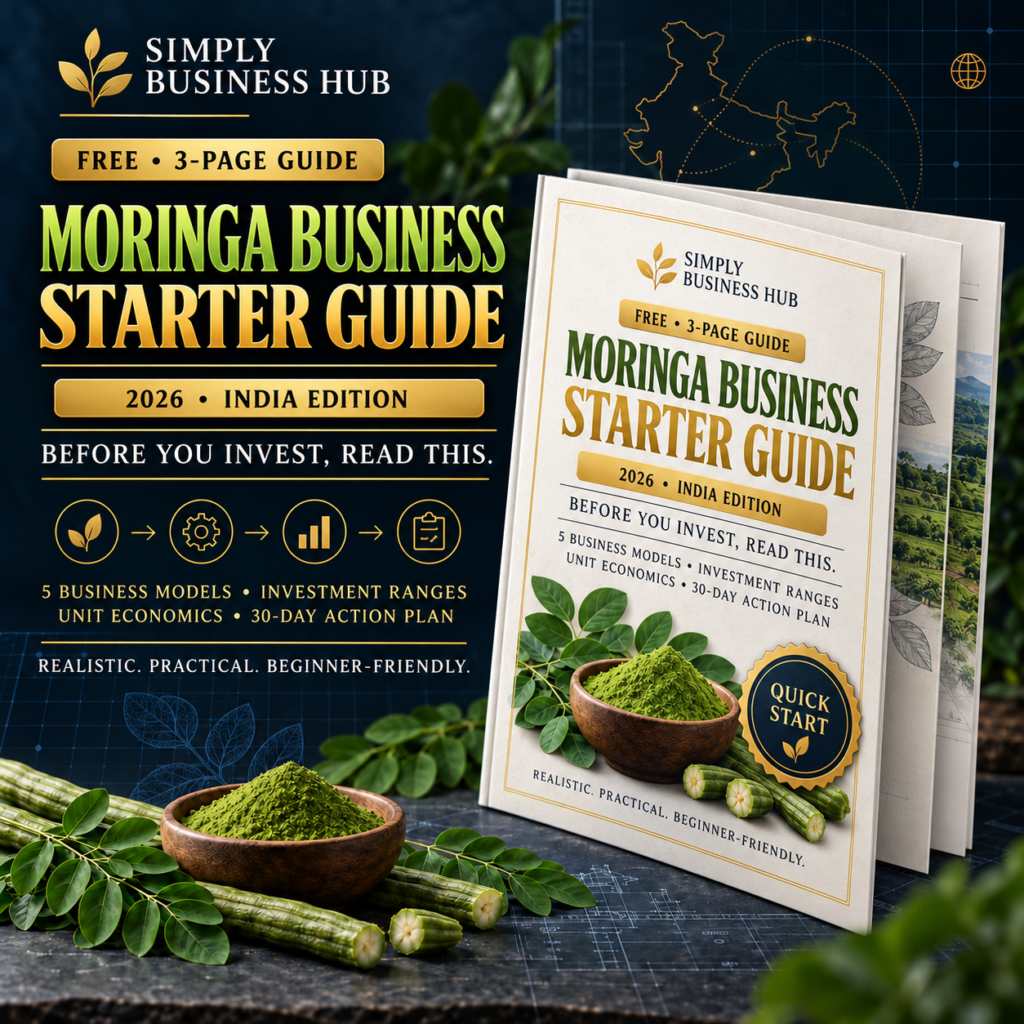
Moringa business in India is often promoted as a high-profit farming or powder opportunity. The reality is more useful: moringa can support several viable business models, but success depends on choosing the right buyer, controlling quality and validating demand before investing heavily in land, machinery or stock.
The correct starting order: Buyer → Product → Investment. Start with a clearly defined customer, a compliant product and a small paid pilot. Scale only after the numbers work.
Is the moringa business profitable in India?
It can be commercially viable, but moringa is not an automatic-profit crop or a passive-income shortcut. Industry reports use different definitions, yet several 2026 estimates place the global moringa-products market at roughly US$10–11 billion, with forecast annual growth around 9–11%. Demand spans food supplements, functional beverages, personal care and bulk ingredients. Market growth indicates opportunity; it does not guarantee demand for your product.
The practical question is not “Is moringa growing?” It is: Which customer will buy my exact product, at what price, and what contribution remains after every variable cost?
Five practical moringa business models
1. Fresh moringa pods
Grow and sell drumsticks to local traders, retailers, hotels, caterers or institutions. This model suits growers with dependable local demand, efficient harvesting and short transport distances.
2. Fresh moringa leaves
Supply cleaned and graded leaves to local food processors, herbal-product makers or institutional buyers. Fresh leaves are perishable, so handling speed and confirmed offtake matter more than optimistic yield projections.
3. Moringa powder and tea
Process leaves into powder or tea cuts for wholesale or retail. The commercial challenge is consistent colour, moisture control, hygiene, traceability, laboratory testing and shelf-life evidence—not merely buying a pulveriser.
4. Own D2C moringa brand
Source from a qualified third-party manufacturer and sell consumer packs through Instagram, marketplaces or your own website. This is often the most practical pilot route for beginners because it tests branding, pricing, customer acquisition and repeat demand without immediately owning a farm or factory.
5. B2B and export supply
Supply bulk powder, dried leaves, seeds or oil against a buyer specification. This route can scale, but it is specification-led: obtain written quality requirements and commercial terms before producing an export batch.
Does this business suit you?
It may suit you if: you can run a small pilot, build trust around quality, sell consistently and use real sales data to make decisions.
Avoid starting now if: you expect instant passive income, do not have a buyer hypothesis, or plan to put most of your capital into land, machines or unsold stock before validation.
How to start a moringa business in India
Step 1: Identify one narrow buyer
Choose one customer segment: health-conscious working adults, fitness buyers, families seeking convenient greens, a local institutional buyer or a specific B2B processor. Speak with at least 15–20 prospects. Learn what format they want, what they already buy, their concerns, preferred pack size and acceptable price.
Step 2: Qualify at least three suppliers
Compare FSSAI status, facility hygiene, batch traceability, recent test reports, minimum order quantity, packaging options, lead time, storage practices and complaint or recall procedures. A low quote without verifiable quality control is not a saving.
Step 3: Build complete unit economics
Work backward from the expected selling price. Include product, pouch, label, testing allocation, payment fee, shipping, marketplace commission, returns, damaged stock and customer-acquisition cost. Revenue is not profit.
Step 4: Launch a 100–300 pack pilot
Use one primary sales channel and one backup channel. Start with a simple product, compliant communication and limited inventory. Measure conversion, contribution per order, customer complaints, feedback and repeat intent.
Step 5: Scale only after proof
Increase inventory gradually when you can repeatedly acquire customers at workable economics and maintain consistent quality. Consider machinery or farming expansion only after demand, specifications and working-capital requirements are clear.
Moringa business investment: realistic planning ranges
Brand-first pilot: ₹1.5–4 lakh. The main cost drivers are supplier MOQ, samples, laboratory tests, packaging, design, website or marketplace setup, initial content and launch marketing.
One-acre pod farming: ₹1.5–3 lakh+. This indicative band covers planting, labour and inputs but excludes land purchase and major water infrastructure. Local conditions can change the requirement substantially.
Micro processing unit: ₹8–15 lakh. Drying, milling, sieving, hygienic handling, testing, packing, electrical work and working capital drive the cost.
Export-ready setup: ₹25–60 lakh+. Traceability, buyer-specific tests, documentation, certifications, inventory, samples and the payment cycle can require materially more capital.
Important: These are planning bands—not supplier quotations or guaranteed setup costs. Location, scale, automation, raw-material source, certification and working-capital cycle can materially change the investment.
Moringa powder business profit: a realistic D2C example
Assume one customer order contains two pouches and pays ₹549. Product, packing, testing allocation, payment fee and delivery total approximately ₹235. If customer-acquisition cost is ₹150, the order leaves ₹164 as post-ad contribution.
₹549 sale − ₹235 variable fulfilment cost − ₹150 customer acquisition = ₹164 contribution.
The ₹164 is not net profit. Rent, salaries, software, professional fees, returns, taxes and other fixed costs still have to be deducted. Actual figures will vary by product, order size, channel, location and return rate.
Processing and quality checklist
Raw material: Define leaf maturity, harvest handling, foreign-matter limits, traceability and rejection criteria with the supplier.
Processing: Prevent contamination during washing, drying, milling, sieving and packing. Use documented hygiene and batch controls.
Testing: Agree product-specific specifications and use an appropriate accredited laboratory. Depending on the buyer and product, testing may include moisture, microbiology, heavy metals, pesticide residues and nutritional parameters.
Packaging and shelf life: Use food-grade material suitable for moisture and oxygen protection. Establish shelf life through evidence rather than guesswork.
Claims: Do not state that moringa cures, prevents or treats disease. Use only permitted, accurate and supportable claims.
FSSAI and labelling essentials for 2026
From 1 April 2026, the turnover thresholds are FSSAI Registration up to ₹1.5 crore; State Licence above ₹1.5 crore and up to ₹50 crore; and Central Licence above ₹50 crore. However, turnover is only one test. Your Kind of Business, activity, product category, capacity, premises and export status may change the applicable requirement. Confirm the current criteria on FoSCoS before operating.
For pre-packaged moringa food, the label may need, as applicable, the true name of food, ingredients, nutrition information, vegetarian symbol, net quantity, lot or batch, date marking, storage and usage instructions, manufacturer or marketer details, FSSAI logo and number, customer-care details, MRP and Legal Metrology declarations. Review the final artwork before printing bulk packaging.
Moringa export from India: buyer first
Find the buyer and obtain a written specification before producing an export batch. Exporters generally need an Importer-Exporter Code from DGFT. For APEDA-scheduled products, exporters can apply for e-RCMC after obtaining IEC. Check the destination country’s ingredient, contaminant, pesticide-residue, organic-claim, phytosanitary, packaging and labelling requirements. Sample acceptance is not the same as a purchase order.
Your first 30-day action plan
Week 1: Choose one business model and interview target buyers. Output: a clear buyer profile and problem statement.
Week 2: Compare three suppliers, samples, documents and landed costs. Output: a supplier scorecard.
Week 3: Review compliance, packaging, pricing and complete unit economics. Output: a pilot-ready offer and break-even logic.
Week 4: Launch 100–300 packs and measure results. Output: sales, contribution, feedback and repeat-intent data.
Want the complete end-to-end Moringa Business Blueprint?
Explore model selection, sourcing, processing, machinery, licences, investment planning, unit economics, branding, sales and export roadmaps in one structured guide.
Important disclaimer
This article is for general educational and informational purposes only. It is not financial, legal, tax, agricultural, food-safety, medical, investment or export advice, and it does not guarantee sales, profits, approvals or business success. Market estimates and cost examples are illustrative and may differ by source, scope, location, scale and date. Regulations, fees, licence categories and buyer requirements can change. Before investing or selling, independently validate demand, obtain current quotations, conduct due diligence, verify applicable rules with FSSAI/FoSCoS, DGFT, APEDA and other competent authorities, and consult qualified professionals. Simply Business Hub and the author are not responsible for decisions, losses, claims or outcomes arising from reliance on this article.
Sources and further verification
PIB: FSSAI regulatory reforms effective 1 April 2026
FSSAI: Labelling and Display Regulations
DGFT: Importer-Exporter Code
APEDA: Registration-Cum-Membership Certificate
Grand View Research: Moringa products market
Fortune Business Insights: Moringa products market