Quick answer: A small pebble art frame business can
be tested from home with approximately ₹3,000–₹7,000 if you begin with
sample pieces and buy frames only after receiving orders. A more
comfortable launch budget is ₹7,000–₹10,000. The opportunity is
strongest when the product is sold as a personalized gift—not as a
collection of ordinary stones.
What Is a Pebble Art Frame
Business?
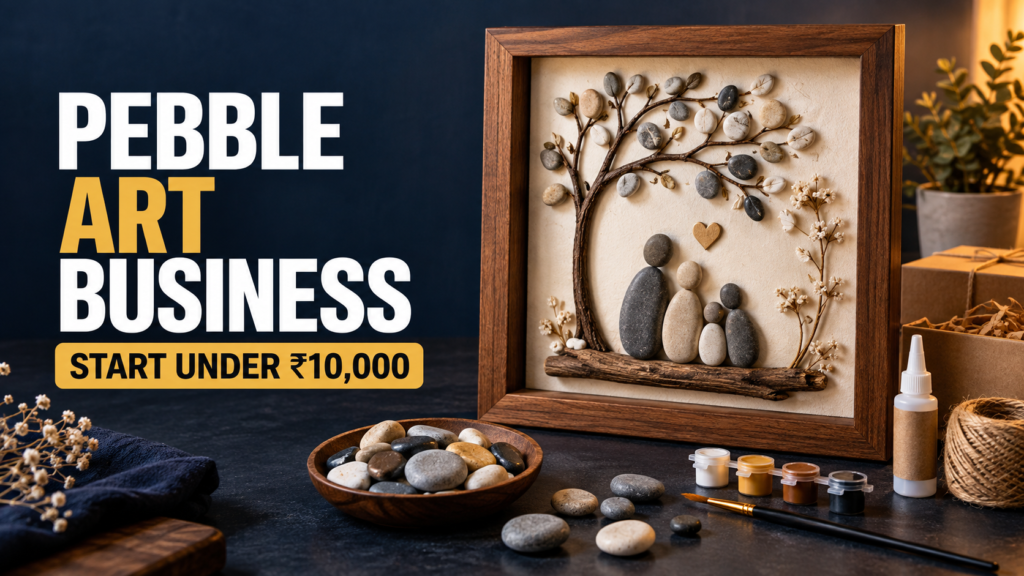
Pebble art uses natural or craft pebbles, twigs, paint, lettering and
other small decorative elements to create simple three-dimensional
scenes inside a frame. Popular themes include couples, families, pets,
friendships, weddings, anniversaries, new homes and memorial gifts.
The raw materials are inexpensive, but the customer is paying for
four things:
- The story represented by the artwork
- Personalization with names, dates or messages
- Handmade craftsmanship
- Gift-ready presentation
That makes this a value-added creative business, not
a commodity-reselling business.
Indian sellers already offer pebble art in multiple price bands. At
the time of this guide, Pebble Path listed 10 × 12-inch frames around
₹1,500 and 12 × 14-inch frames around ₹2,500; Batoony displayed
personalized family artwork from about ₹2,999; and curated craft
marketplace Zwende showed some personalized pebble art from around
₹3,200. These are market observations—not guaranteed selling prices—but
they show that customers may pay more when design, personalization,
finish and brand presentation improve.
Who Can Start This Business?
This model may suit:
- Artists and craft creators
- Homemakers seeking a home-based business
- Students testing a creative side hustle
- Gift-shop owners adding personalized products
- Wedding and event vendors
- Instagram creators building a handmade brand
You do not need advanced drawing skills to begin, but you do need
patience, a good eye for composition, clean finishing and reliable order
handling.
Recommended Business Model
The safest beginner model is made to order.
Create five to eight strong samples, photograph them professionally,
and accept customized orders with an advance payment. Buy or allocate
the final frame after confirming the design and size. This reduces
unsold stock and protects cash flow.
Use three product tiers:
| Tier | Product | Suggested test price | Best for |
|---|---|---|---|
| Starter | Small, simple design with one short message | ₹699–₹999 | Birthdays, friends, desk décor |
| Signature | 8 × 10 or 10 × 12-inch customized family/couple frame | ₹1,299–₹2,199 | Anniversaries, weddings, housewarming |
| Premium | Larger multi-person, pet, layered or shadow-box artwork | ₹2,499–₹4,500+ | Premium gifts, corporate and wedding orders |
These are suggested testing ranges. Your actual price must reflect
frame quality, design complexity, labour time, packaging, shipping,
taxes, platform fees and local demand.
Complete Material List
Core materials
| Material | Purpose | Starter buying advice |
|---|---|---|
| Smooth pebbles in varied sizes | People, heads, bodies, landscapes | Buy cleaned craft pebbles or ethically collect only where permitted |
| Wooden, MDF or shadow-box frames | Final product structure | Begin with two or three standard sizes |
| MDF board, mount board or canvas | Artwork base | Choose a rigid, moisture-resistant base |
| Strong craft adhesive or epoxy | Fixes stones and heavier elements | Test adhesion and drying marks before selling |
| Acrylic paints | Colour and detailing | Start with black, white, primary colours and metallic accents |
| Paint brushes and dotting tools | Faces, text and fine accents | One fine liner brush is essential |
| Twigs, dried leaves and preserved moss | Trees and natural scenes | Ensure they are dry, clean and pest-free |
| Lettering pens or vinyl letters | Names, dates and messages | Use waterproof, fade-resistant materials |
| Clear protective coating | Optional surface protection | Test first; some coatings alter stone colour |
| Gloves, tweezers and palette knife | Handling and positioning | Helps produce cleaner work |
Packaging materials
- Corrugated box slightly larger than the frame
- Bubble wrap or honeycomb paper
- Corner protectors
- Tissue paper and thank-you card
- Fragile label
- Moisture-resistant inner cover
- Branded sticker or care card
Photography and selling
tools
- Smartphone with a clean camera lens
- Neutral background or chart paper
- Window light or a basic LED light
- Small tripod
- Canva or another design tool for posts and catalogues
- WhatsApp Business catalogue
- Google Form or order form for personalization details
Starter Budget
| Expense | Lean test budget | Comfortable budget |
|---|---|---|
| Pebbles and natural elements | ₹250 | ₹500 |
| Three to six sample frames | ₹900 | ₹2,000 |
| Base boards/canvas | ₹250 | ₹600 |
| Adhesives | ₹300 | ₹700 |
| Acrylic paints and brushes | ₹500 | ₹1,000 |
| Lettering and décor materials | ₹300 | ₹700 |
| Packaging samples | ₹400 | ₹1,000 |
| Basic photo setup/props | ₹300 | ₹1,000 |
| Trial, breakage and miscellaneous | ₹500 | ₹1,000 |
| Estimated total | ₹3,700 | ₹8,500 |
Prices vary by city, quality, pack size and supplier. Do not spend
the entire budget on frame inventory before validating demand.
Step-by-Step Production
Process
- Confirm the occasion and story. Ask who the gift is
for, the number of people or pets, names, date, preferred message and
deadline. - Select the frame size. Decide the usable inner area
before designing. - Create a rough layout. Arrange the pebbles without
adhesive and photograph the layout. - Get customer approval. For custom orders, share a
low-resolution preview before permanent fixing. - Prepare the base. Clean it and add the background,
lettering or painted elements. - Clean and dry the pebbles. Moisture or dust can
weaken adhesion. - Fix the composition. Use the correct adhesive and
allow full curing time. - Add details. Paint small elements, names, dates,
branches or accents. - Quality-check. Shake-test gently, inspect glue
marks, clean the glazing and verify spelling. - Photograph and pack. Capture the finished work
before dispatch and protect every corner.
Never promise same-day dispatch until you know the adhesive curing
time and your packaging process.
Pricing Strategy
That Protects Your Profit
Do not price the frame by looking only at the cost of pebbles. Use
this formula:
Selling price = materials + packaging + labour + overhead
allocation + platform/payment fees + damage allowance + desired
profit
Sample costing:
customized 10 × 12-inch frame
| Cost item | Illustrative amount |
|---|---|
| Frame and base | ₹350 |
| Pebbles, paint, glue and décor | ₹120 |
| Personalization and printing | ₹40 |
| Protective packaging | ₹140 |
| Labour: 1.5 hours | ₹300 |
| Payment/platform allowance | ₹60 |
| Breakage/overhead allowance | ₹90 |
| Estimated total cost | ₹1,100 |
If this design sells for ₹1,699, the illustrative contribution before
tax and broader business expenses is ₹599. If shipping is included,
subtract the actual courier charge as well.
Use complexity add-ons
- Additional person or pet: ₹150–₹350
- Hand-lettered long message: ₹100–₹250
- Urgent order: 15%–25% surcharge
- Premium shadow-box frame: charge the actual upgrade plus margin
- Gift wrapping: ₹99–₹249
- Shipping: charge separately until average shipping cost is
known
Collect at least 50% advance for customized orders.
For heavily personalized pieces that cannot be resold, a 100% prepaid
policy is safer.
Products Most Likely to Sell
Start with designs linked to a clear gifting occasion:
- Couple and anniversary frames
- Family of three, four or five
- Wedding-date keepsakes
- Newborn family frames
- Pet-parent artwork
- Best-friend frames
- Housewarming and new-home frames
- Teacher or colleague appreciation gifts
- Memorial and remembrance frames
- Corporate team or founder gifts
Avoid launching 50 random designs. Begin with eight excellent samples
covering the most common occasions.
Selling Plan
1. Instagram
Instagram is ideal because the making process is visually satisfying.
Publish:
- Pebbles-to-frame transformation Reels
- Close-up craftsmanship shots
- Customer story and final reveal
- Packaging videos
- “Choose the better layout” polls
- Occasion-led posts before festivals and wedding seasons
Every post should direct viewers to one action: DM or
WhatsApp the word PEBBLE for the catalogue.
2. WhatsApp Business
Create catalogue categories for Starter, Signature and Premium
frames. Use a standard order form containing:
- Customer name and mobile number
- Occasion
- Names and date to be written
- Number of people/pets
- Preferred colour and frame size
- Required delivery date
- Delivery PIN code
- Approved message and spelling
3. Local partnerships
Approach gift shops, florists, wedding planners, photographers,
bakeries and event decorators. Offer a sample catalogue and either:
- A wholesale price for repeat orders, or
- A 15%–25% referral commission based on your margin
Do not agree to commissions before calculating packaging, rework and
delivery costs.
4. Online marketplaces
Marketplaces may provide discovery, but account for listing fees,
commissions, advertising, returns and payment settlement time. Build
direct Instagram and WhatsApp demand first, then test marketplaces with
a small catalogue.
5. Corporate and bulk gifting
Develop designs for employee milestones, team appreciation, client
gifting and event souvenirs. Standardize the frame size and layout so
bulk orders remain profitable.
Simple Launch Offer
Instead of giving a large discount, use an offer that preserves
value:
First 20 orders: free name and date personalization plus a
handwritten gift note.
This is more premium than discounting every product and costs little
to fulfil.
30-Day Launch Plan
Week 1: Build the product
- Choose three frame sizes
- Create eight sample designs
- Record the time and cost of every sample
- Test adhesive strength and packaging
Week 2: Build the storefront
- Create an Instagram page and WhatsApp catalogue
- Photograph each sample in natural light
- Prepare price cards, order policy and customization form
- Create five Reels from the making process
Week 3: Validate demand
- Post consistently
- Offer samples to two local gift businesses
- Collect ten genuine enquiries
- Track which occasions, sizes and price points receive interest
Week 4: Improve and sell
- Launch the first-order value offer
- Follow up with serious enquiries
- Ask buyers for an unboxing photo or video
- Stop low-interest designs and repeat the strongest themes
Your first target should be five paid orders with positive
contribution, not a large revenue claim.
Example Monthly Scenario
Assume you receive 20 orders at an average selling price of
₹1,499.
| Item | Illustrative calculation |
|---|---|
| Revenue | ₹29,980 |
| Average variable cost: ₹850 × 20 | ₹17,000 |
| Illustrative contribution | ₹12,980 |
This contribution is not guaranteed profit. Advertising, returns,
taxes, tools, internet, unsold samples, your time and other overheads
may reduce the final amount. Actual results depend on design quality,
pricing and sales consistency.
Packaging and Shipping
Checklist
- Let adhesive cure completely before packing
- Use corner protection on every frame
- Prevent the artwork or glazing from touching the outer box
- Conduct one test shipment to another city
- Record a packing video for high-value orders
- Display a clear damage-reporting window
- Avoid cash on delivery for fully customized products unless the risk
is covered
Common Mistakes to Avoid
- Pricing only by material cost and ignoring labour
- Buying too many frames before orders arrive
- Using weak glue or shipping before full curing
- Accepting personalization through scattered chat messages
- Failing to confirm spelling before fixing the design
- Copying another artist’s exact design
- Offering free shipping without knowing courier cost
- Using fragile glass without adequate packaging
- Promising unrealistic income or margins
- Posting only finished products instead of showing the story and
process
Basic Registration and
Compliance
This is generally a craft and gift-product business, but the
requirements depend on your structure, turnover, selling locations and
platforms.
- Keep purchase, sales and customer-payment records from day one.
- Consider Udyam registration if eligible; use only the official
government portal, which describes the registration process as free and
paperless. - Check GST registration and e-commerce implications with a qualified
tax professional because thresholds and exceptions can differ by state,
supply type and selling channel. - Use licensed fonts, illustrations and artwork. Do not copy
copyrighted characters or another creator’s exact composition. - Publish clear policies covering customization approval,
cancellation, returns, breakage and delivery delays.
Final Verdict
Pebble art frames can be a sensible low-investment test business
because production can begin from home, inventory can remain small, and
personalization creates meaningful value. However, success does not come
from the stones themselves. It comes from design quality, emotional
storytelling, premium finishing, accurate pricing, reliable packaging
and consistent marketing.
Begin with eight strong samples, validate five paid orders, measure
the real time and cost for each design, and scale only the styles
customers repeatedly choose.
Useful Market References
- Pebble Path product listings —
examples of size-based pebble art pricing - Batoony personalized pebble art —
premium positioning and occasion-based collections - Zwende pebble art listings —
curated handmade-product positioning - Official Udyam
Registration portal — MSME registration information
Related Business Guides
Disclaimer
This guide is for educational purposes only. Costs, prices, margins,
demand, platform fees, shipping charges and legal or tax requirements
vary by location and may change over time. The figures shown are
illustrative estimates and not promises of income or profit. Validate
demand with small paid orders, obtain current supplier quotations, test
product safety and packaging, and consult qualified tax or legal
professionals before making significant investments or compliance
decisions.