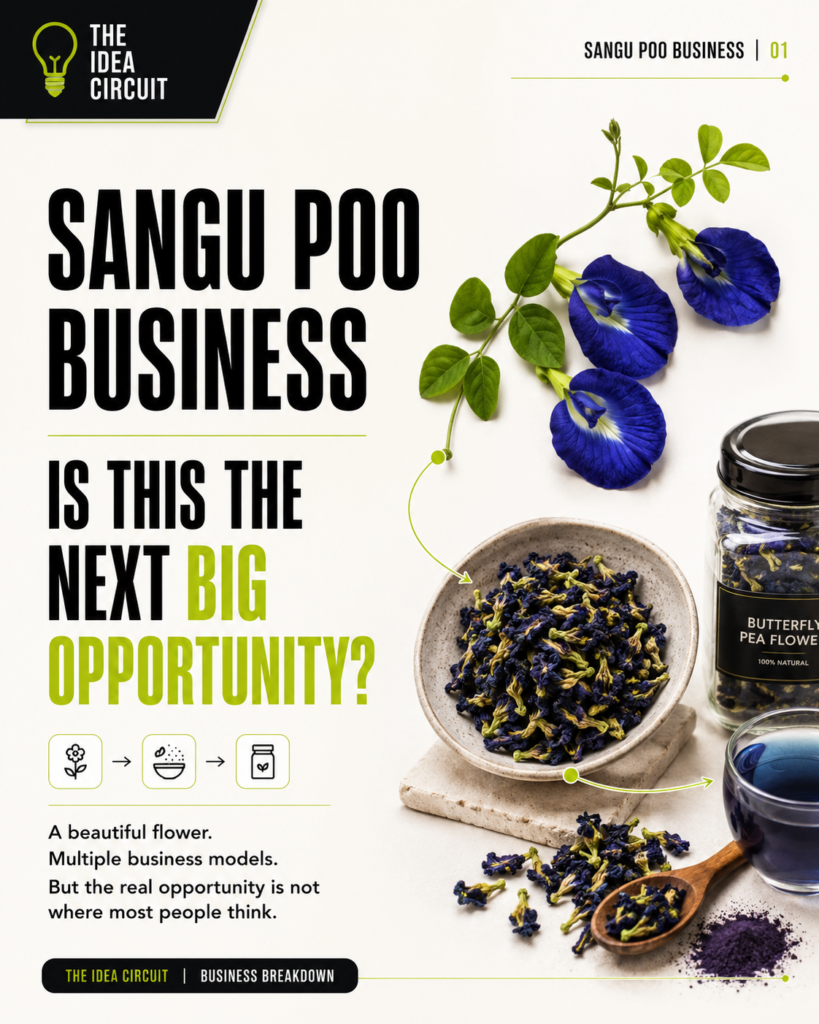
Butterfly Pea is instantly recognisable because of its vivid blue flowers and naturally colour-changing infusion. In India, it is commonly known as Sangu Poo and scientifically identified as Clitoria ternatea.
But behind this beautiful flower is a more interesting question:
Can Butterfly Pea become a practical business opportunity in India?
The answer is yes—but not necessarily in the way most people imagine.
Simply cultivating Butterfly Pea and waiting for buyers is not a complete business model. The larger opportunity may exist across the value chain: sourcing, drying, grading, testing, packaging, branding, natural-colour applications and supplying ingredients to other businesses.
This guide explains the basic Butterfly Pea business opportunity, the different ways to enter the market, indicative investment requirements and the important checks to complete before investing.
Why Is Butterfly Pea Attracting Business Interest?
Butterfly Pea flowers contain natural blue pigments called anthocyanins, particularly a group of polyacylated anthocyanins known as ternatins.
These pigments give the flower its distinctive blue colour. They also react to changes in pH, allowing a blue infusion to change towards purple or pink when acidic ingredients such as lemon are added.
This visual characteristic has created interest across several product categories:
- Botanical and herbal infusions
- Cafés, mocktails and mixology products
- Natural food-colour applications
- Dried-flower ingredients
- Premium wellness products
- Cosmetic ingredient development
- Extracts and food-processing applications
Scientific research also supports the potential use of Butterfly Pea anthocyanins as natural colour ingredients. However, colour performance can depend on processing method, pH, temperature, exposure to light and storage conditions.
Therefore, commercial success depends on more than simply growing blue flowers. Buyers need consistent colour, controlled moisture, acceptable purity and reliable supply across multiple batches.
The Real Butterfly Pea Business Opportunity
The complete Butterfly Pea value chain looks approximately like this:
Cultivation → Harvesting → Sorting → Drying → Grading → Testing → Storage → Processing → Packaging → Selling
Every stage introduces additional work, cost and potential value.
A farmer may sell fresh or basic dried flowers. An aggregator can purchase flowers from several growers, standardise the quality and supply graded material to businesses. A consumer brand can package the dried flowers as a botanical infusion. A technically capable company may develop extracts for food, beverage or cosmetic manufacturers.
This is why the right question is not:
“Can I grow Sangu Poo?”
The more useful question is:
“Which part of the Butterfly Pea value chain can I operate profitably?”
Five Butterfly Pea Business Models to Consider
1. Cultivation and bulk flower supply
In this model, Butterfly Pea is cultivated and supplied as fresh or dried flowers to aggregators, herbal-product businesses, processors or ingredient buyers.
This model may suit:
- Existing farmers
- Landowners
- Farmer groups
- Entrepreneurs with confirmed local buyers
Cultivation alone can involve weather risk, labour-intensive flower picking and uncertain farm-gate prices. Before planting at commercial scale, obtain genuine buyer quotations and understand the required flower grade.
Do not depend on online marketplace listing prices when calculating expected farm revenue. A listed selling price is not necessarily the amount a farmer or new supplier will receive.
2. Aggregation, drying and grading
Instead of cultivating the entire requirement, the entrepreneur sources Butterfly Pea flowers from multiple growers and focuses on:
- Sorting
- Controlled drying
- Moisture checking
- Grading
- Storage
- Packaging
- B2B supply
This can be a practical entry model because the entrepreneur is solving a genuine supply-chain problem: inconsistency.
A serious buyer may care more about receiving the same colour, moisture level, purity and grade in every batch than about which individual farm produced the flower.
The major challenges in this model include quality control, supplier reliability, working capital and finding repeat buyers.
3. D2C botanical-infusion brand
Butterfly Pea flowers can be packaged and sold directly to consumers through:
- A brand website
- Online marketplaces
- Social media
- Retail shops
- Cafés and wellness stores
This model can offer an attractive retail selling price, but selling price should never be confused with profit.
A D2C brand must account for:
- Raw material
- Sorting and processing
- Packaging
- Testing
- Payment-gateway or marketplace fees
- Shipping and fulfilment
- Discounts and returns
- Content and advertising
- Customer-acquisition cost
A product can appear to have a high gross margin and still lose money after fulfilment and marketing expenses.
Start with one focused SKU, test demand with a small quantity and measure whether customers return for another purchase.
4. Natural colourant or extract business
Butterfly Pea has commercial potential as a natural blue colour source for food and beverage applications.
However, a simple home-made infusion is not the same as a standardised commercial extract.
Commercial buyers may require:
- Batch consistency
- Colour specifications
- Defined solubility
- Stability information
- Microbial testing
- Pesticide-residue testing
- A certificate of analysis
- Technical documentation
For a new entrepreneur, partnering with an established food technologist or contract manufacturer may be more practical than immediately investing in extraction machinery.
5. Cosmetic ingredient supply
Butterfly Pea powders and extracts are also being explored for cosmetic and personal-care formulations.
This is a specialised B2B opportunity rather than an easy home-manufacturing business. Cosmetic manufacturers may require stricter microbial, purity, heavy-metal and stability specifications.
A realistic beginner route may be supplying properly tested raw material or working with an established formulation and contract-manufacturing partner.
Avoid making unverified claims about treating skin, hair or medical conditions. Traditional usage and early scientific research should not be presented as guaranteed human benefits.
How Much Investment Is Required?
Investment depends heavily on the chosen business model.
The following are broad, illustrative planning ranges—not vendor quotations or guaranteed budgets.
Validation stage: approximately ₹50,000 to ₹1.5 lakh
This may cover:
- Small sample purchases
- Basic drying or sorting arrangements
- Weighing equipment
- Moisture measurement
- Sample packaging
- Initial laboratory testing
- Buyer outreach
- Small pilot batches
At this stage, the goal is not to build a full facility. The goal is to confirm whether buyers will purchase the product at a commercially workable price.
Small commercial operation: approximately ₹2 lakh to ₹6 lakh
Depending on capacity and outsourcing decisions, this could include:
- Small drying equipment
- Sorting tables
- Moisture meter
- Sealing or packaging equipment
- Initial packaging material
- Outsourced testing
- Storage arrangements
- Working capital for supplier payments
Working capital is particularly important. Growers and suppliers may need to be paid before the final buyer pays you.
Larger processing operation: approximately ₹10 lakh to ₹40 lakh or more
This may involve higher-capacity dehydration, dedicated processing infrastructure, stronger quality-control systems, cold or controlled storage and a larger packaging operation.
This level of investment should only be considered after repeat demand and real unit economics have been demonstrated.
Revenue Is Not Profit
One of the biggest mistakes in a Butterfly Pea business plan is calculating profit using only the difference between the raw-flower cost and the final selling price.
A better calculation is:
Selling price
− Variable product cost
− Processing and packaging
− Fulfilment and platform fees
− Discounts and returns
− Customer-acquisition cost
= Contribution per unit
Fixed expenses such as rent, permanent salaries, administration and other overheads must then be considered before estimating operating profit.
Before scaling, calculate:
- Cost per saleable unit
- Drying and processing loss
- Packaging cost
- Testing cost
- Logistics cost
- Marketplace commission
- Customer-acquisition cost
- Expected repeat-order rate
- Break-even sales volume
Never build the business around the highest online selling price you can find.
How to Validate the Market Before Investing
A simple validation process can protect the entrepreneur from unnecessary machinery, inventory and cultivation expenses.
Step 1: Identify ten realistic buyers
Depending on the chosen model, potential buyers may include:
- Botanical-infusion brands
- Cafés and mixology businesses
- Natural ingredient distributors
- Food and beverage manufacturers
- Cosmetic formulators
- Wellness-product companies
- Export-oriented traders
Choose buyers whose expected order volumes match your initial capacity.
Step 2: Prepare samples and specifications
A professional sample should communicate:
- Botanical name
- Plant part supplied
- Product format
- Colour and grade
- Packaging format
- Available quantity
- Testing information
- Indicative price
- Minimum order quantity
Do not invent quality specifications. Ask prospective buyers what parameters they require.
Step 3: Collect real commercial feedback
Ask potential buyers:
- What grade do you currently purchase?
- What quality problems do you experience?
- How much do you normally order?
- What documentation or testing do you need?
- What price range would you consider?
- Would you test a small pilot order?
General encouragement is not market validation. A sample request, quotation request or pilot-order commitment is a stronger signal.
Step 4: Run a small pilot
Supply a limited quantity and track:
- Actual production cost
- Drying loss and wastage
- Quality consistency
- Final price realised
- Buyer feedback
- Payment period
- Possibility of a repeat order
Step 5: Scale, modify or stop
After the pilot, make an honest decision:
- Scale if demand is repeatable and the economics are workable.
- Modify if buyers are interested but price, quality or positioning needs improvement.
- Stop if there is no genuine buyer commitment or no realistic path to break-even.
Stopping after a weak pilot is not failure. It is successful capital protection.
Common Butterfly Pea Business Mistakes
Avoid these common errors:
- Cultivating a large area before identifying buyers.
- Treating online retail prices as farm-gate income.
- Buying drying or extraction machinery before running a pilot.
- Ignoring moisture control, storage and microbial risk.
- Launching too many D2C products at once.
- Assuming a premium price automatically creates profit.
- Underestimating packaging, logistics and customer-acquisition expenses.
- Making unsupported medical or wellness claims.
- Using the same quality standard for food, cosmetics and extracts.
- Depending on one supplier or one major buyer.
Licences and Compliance
The applicable requirements depend on what you manufacture and how you sell it.
Businesses dealing with processed, packaged or consumer-facing food products may need appropriate FSSAI registration or licensing, compliant labels and Legal Metrology declarations.
Cosmetic products and cosmetic manufacturing involve a different regulatory framework. Extract manufacturing may introduce additional food-processing and technical-compliance requirements.
For packaged Butterfly Pea beverages or dried-flower infusions, verify the currently permitted product name and label terminology before printing packaging. Avoid unsupported disease-treatment, therapeutic or guaranteed wellness claims.
Consult an appropriate food technologist, regulatory professional, chartered accountant or local licensing authority based on the chosen model.
Who Is This Business Suitable For?
The Butterfly Pea business may suit someone who:
- Is willing to contact buyers directly
- Can maintain consistent quality
- Understands that validation comes before investment
- Can manage suppliers and working capital
- Is comfortable beginning with a small pilot
- Can remain operationally involved
- Is prepared for the first few cycles to be a learning stage
It may not suit someone looking for passive income, immediate profit, guaranteed returns or a business that can be built without buyer follow-up.
Final Verdict: Is the Sangu Poo Business Worth Exploring?
Butterfly Pea is a genuine but specialised business opportunity.
It should not be treated as a guaranteed high-income crop or an instant D2C success. The strongest opportunity may lie in supplying consistency—proper drying, grading, documentation, dependable quality and reliable fulfilment.
For many first-time entrepreneurs, a sensible approach is:
- Source small samples.
- Approach realistic buyers.
- Understand their specifications.
- Obtain genuine price feedback.
- Run a small pilot.
- Invest only after repeat demand becomes visible.
The business should begin with buyer conversations—not land, machinery or bulk inventory.
Get the Complete Butterfly Pea Business Blueprint
This article gives you the foundation. The complete premium blueprint goes much deeper into the commercial decision.
Inside the full Butterfly Pea Business Blueprint, you will find:
- Detailed comparison of five business models
- Indicative investment and CAPEX ranges
- Cultivation and aggregation economics
- D2C unit-economics breakdown
- B2B buyer categories and sales strategy
- Processing and value-addition options
- Operational workflow and quality checkpoints
- Buyer-outreach playbook
- Capital-to-model decision matrix
- Risk and compliance framework
- Pre-investment checklist
- Practical 90-day validation and execution plan
- Clear scale, modify or stop decision criteria
It is not a “get rich quickly” guide. It is designed to help you decide whether to start, test, delay or avoid this business—before committing significant capital.
[GET THE COMPLETE BUTTERFLY PEA BUSINESS BLUEPRINT]
Make the decision with a framework, not assumptions.
Disclaimer: This article is for educational purposes and does not constitute financial, legal, agronomic or regulatory advice. Investment ranges are illustrative. Prices, costs, yields, regulations and business outcomes vary. Conduct independent due diligence and consult qualified professionals before investing.