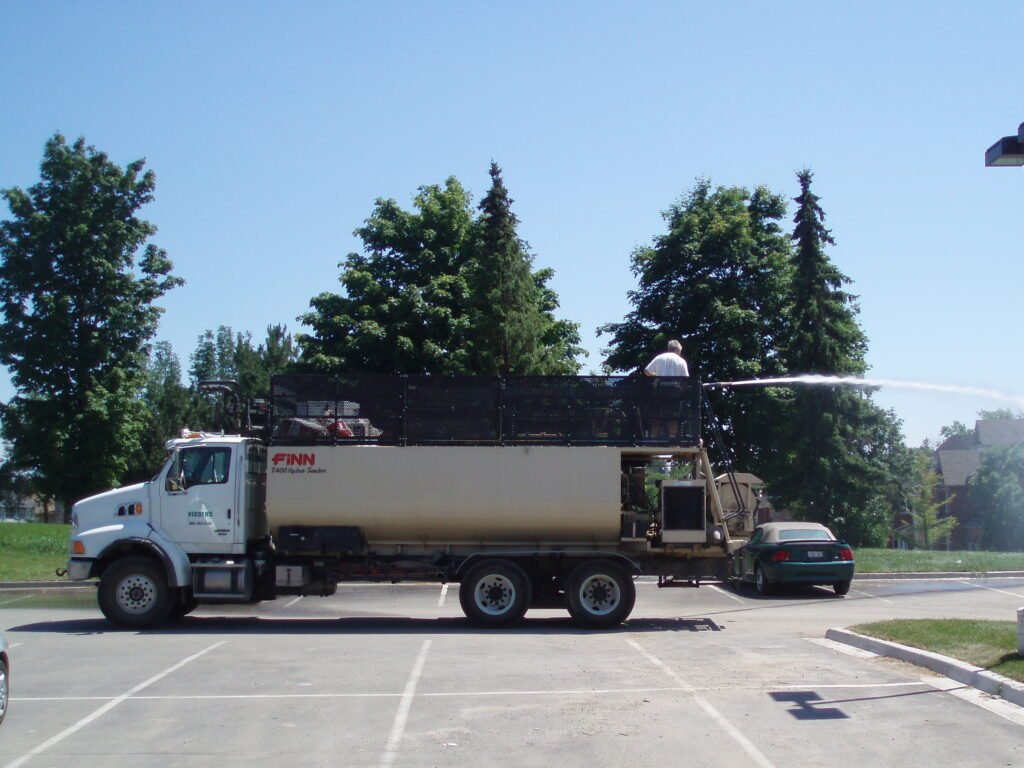
Hydroseeding is emerging as a niche B2B service opportunity in India for landscaping, slope stabilisation, erosion control, road projects, resorts, campuses, sports grounds and land-reclamation work. Instead of manually sowing grass over a large area, a hydroseeder sprays a slurry of seed, water, mulch, fertiliser and other additives over prepared soil.
For an entrepreneur, the opportunity is not just to sell grass. The stronger model is to sell a complete hydroseeding service: site assessment, material selection, slurry preparation, spraying, irrigation guidance and, where required, maintenance until vegetation is established.
Business type: B2B landscaping / erosion-control service
Target customers: Builders, resorts, schools, factories, landscape contractors, highways, mining and government projects
Indicative service reference: roughly ₹350–₹800 per sq. metre in several Indian market/tender references, with specialised engineered systems going higher
Machine range in India: roughly 500 L to 5,000 L configurations are available from Indian suppliers
Best entry strategy for beginners: validate demand first through a partner/subcontract model before buying a large machine
What exactly is hydroseeding?
Hydroseeding, also called hydraulic seeding or hydromulching, uses a tank-based machine to mix and spray a slurry containing grass or plant seed, water, mulch and fertiliser. Depending on the site, binders or tackifiers, soil amendments and a green tracking dye may also be added.
The technique is useful where conventional seeding is slow, labour intensive or difficult — especially large plots, road embankments, slopes and disturbed land. It does not eliminate the need for proper soil preparation, irrigation or maintenance. Germination and establishment depend on seed type, climate, soil, water and after-care.
Is hydroseeding already being used in India?
Yes. This is not only a foreign landscaping concept. Tamil Nadu’s Highways Department has used hydroseeding with soil-nailing for slope-stabilisation work in the Nilgiris. Indian suppliers also market hydroseeders for road embankments, sports grounds, mining areas, reclaimed land, townships and landscaping projects.
This is important from a business perspective because the addressable market is broader than residential lawns. The real opportunity is in commercial landscaping, infrastructure and land-restoration projects.
Best customer segments
- Real-estate developers and gated communities
- Resorts, hotels and wedding venues
- Schools, colleges and institutional campuses
- Industrial parks and factories
- Sports grounds and large recreational facilities
- Landscape architects and landscaping contractors
- Highway, railway and infrastructure contractors
- Mining and quarry rehabilitation projects
- Municipal bodies and government departments
- Slope stabilisation and erosion-control contractors
Hydroseeding machine options and cost
There is no single fixed machine price. Capacity, pump type, agitation system, throw distance, engine power, trailer/skid/truck mounting and after-sales support can change the cost dramatically.
| Setup | Typical use | Planning range* |
|---|---|---|
| Partner / subcontract model | Validate market without owning machine | ₹1.5–₹3 lakh working budget |
| Compact own-machine setup | Commercial lawns, campuses, smaller sites | ₹8–₹15 lakh total setup |
| Large infrastructure setup | Highways, mines, large slopes, large-area projects | ₹20–₹50 lakh+ depending on machine and vehicle |
*These are planning estimates, not supplier quotations. An Indian manufacturer currently lists hydroseeder capacities from about 500 L to 5,000 L but asks buyers to request pricing. Imported marketplace listings can start around the mid-single-digit lakh range before freight, customs and taxes, while premium imported commercial units can cost several tens of lakhs. Always obtain at least three written quotations before investing.
Raw materials required
- Grass / vegetation seed: species must be selected for local climate, soil and project objective.
- Mulch: cellulose/wood fibre, coir/coconut fibre or other approved mulch materials.
- Fertiliser: usually selected after understanding soil nutrient needs.
- Tackifier or binder: useful on slopes or where erosion risk is higher.
- Soil amendments: may be added where pH, organic matter or structure needs correction.
- Water: both for the slurry and for post-application irrigation.
- Tracking dye: optional; helps operators see coverage during spraying.
Material consumption must be specified project by project. Do not copy a single universal recipe. Slopes, lawns, mine dumps and roadside work can require very different seed and mulch rates.
How much can you charge?
Indian references show wide variation because the scope differs. A private hydroseeding service listing has advertised around ₹350 per sq. metre. Public tender and BOQ references in 2026 show figures around ₹433.75, ₹670 and ₹800 per sq. metre for different scopes, while specialised erosion-control systems can exceed ₹1,000 per sq. metre.
That translates very roughly to about ₹33–₹74 per sq. ft. for the ₹350–₹800/sq. metre band. However, never quote only by copying these numbers. Your final price must account for:
- Area and accessibility
- Slope angle and safety requirements
- Soil preparation
- Seed species and seed rate
- Mulch and binder specification
- Water availability
- Machine transport and mobilisation
- Labour and fuel
- Irrigation and maintenance period
- Performance / survival obligations
Illustrative project economics
Consider a 1,000 sq. metre commercial project quoted at ₹500 per sq. metre. Billing would be ₹5,00,000.
If your project-specific direct cost — materials, transport, machine running, labour, water and agreed maintenance — works out to ₹300 per sq. metre, direct project cost would be ₹3,00,000 and the gross contribution would be ₹2,00,000 before office overhead, finance cost, tax, depreciation, rework and owner salary.
Startup investment breakdown
| Item | What to budget for |
|---|---|
| Machine | Largest single cost; compare Indian and imported options |
| Transport / trailer / pickup | Depends on machine mounting and site distance |
| Hoses, nozzles, pump accessories | Keep spares for field breakdowns |
| Initial consumables | Seed, mulch, fertiliser, binders, dye |
| Site tools and PPE | Rakes, soil tools, safety equipment |
| Working capital | Very important because B2B customers may pay after milestones |
| Marketing and samples | Demo patch, website, brochures, local sales travel |
Best way to start with lower risk
The smartest beginner model is often sell first, buy later.
- Identify a hydroseeding equipment supplier or existing contractor who can execute jobs for you.
- Create a 50–100 sq. metre demo patch and document the result.
- Approach landscaping companies, builders, resorts and civil contractors.
- Quote small paid pilot projects.
- Track your actual material consumption, labour hours, transport cost and rework.
- Buy your own machine only after you can see repeat demand.
This reduces the risk of buying a machine first and then discovering there are too few projects in your local market.
How to find customers
- Partner with landscape architects and garden contractors.
- Visit new villas, resorts, schools and industrial projects before landscaping is completed.
- Build relationships with civil contractors handling slopes, roads and embankments.
- Register for relevant government and infrastructure tenders once you have the required experience and credentials.
- Use before/after video as your strongest marketing asset.
- Create a Google Business Profile and location pages targeting “hydroseeding service + city”.
- Offer a small demonstration patch to serious B2B buyers rather than discounting an entire project.
Licences and compliance
There is no single national “hydroseeding licence” that covers every project. You will generally need the normal registrations applicable to your business, tax and labour setup. Government, highway, mining, forest or environmentally sensitive projects can have additional tender, safety, technical and environmental conditions. Seed selection may also be specified by the client or consultant, particularly where native vegetation is required.
For engineered slope-stabilisation projects, hydroseeding may be only one component of a larger solution involving soil nailing, geogrids, erosion-control blankets or drainage. Do not market a simple lawn hydroseeding service as a substitute for geotechnical engineering.
Main risks in this business
- Poor germination due to wrong seed, temperature or watering
- Heavy rain washing away material before establishment
- Incorrect slurry ratios causing nozzle blockage or poor coverage
- Quoting too low without including mobilisation and maintenance
- Long B2B payment cycles
- Machine downtime when spare parts are unavailable
- Taking on steep-slope work without proper safety or engineering support
30-day launch plan
Week 1: Get three machine quotations, identify two execution partners and shortlist seed/mulch suppliers.
Week 2: Build a demo site, calculate material consumption and create high-quality before/after photos and videos.
Week 3: Contact at least 50 potential B2B customers — landscapers, builders, resorts, campuses and civil contractors.
Week 4: Close one or two pilot jobs, record real costs, collect testimonials and decide whether machine ownership is justified.
Is hydroseeding a good business in India?
Potentially yes — but it is a specialised service business, not a guaranteed quick-profit idea. The strongest markets are locations with active real-estate development, hospitality projects, large institutions, industrial sites, infrastructure work, hilly terrain or erosion-control demand.
If you enter with a sales-first approach, validate demand, partner with technical experts and price projects carefully, hydroseeding can become a differentiated B2B service with less direct competition than conventional landscaping.
Frequently asked questions
How fast does hydroseeded grass grow?
Visible germination can begin within days or weeks depending on the seed species and conditions, but full establishment takes longer. Do not promise a fixed result such as “green lawn in 2–3 weeks” for every site.
Can hydroseeding be done without soil preparation?
Not reliably. The surface may need cleaning, grading, scarification, topsoil improvement or moisture correction before spraying.
Should I buy a machine immediately?
For most first-time entrepreneurs, no. Start with a supplier/partner model, prove demand and then invest.
What is the ideal customer?
A customer with a large area where speed, uniform coverage, labour reduction or erosion control matters more than simply laying a small decorative lawn.
Sources & verification
- Automeck – Hydroseeder range in India
- DT Next – Nilgiris soil-nailing and hydroseeding project
- 2026 tender reference – hydroseeding rate example
- NHAI / project BOQ reference – hydroseeding scope and rate
- Private Indian service listing – pricing reference
Disclaimer: Costs, rates and margins in this guide are indicative and can vary significantly by city, machine, site condition, seed specification, slope, transport, water, labour, tender conditions and maintenance responsibility. Obtain current supplier quotations and site-specific technical advice before investing or issuing a commercial quote.